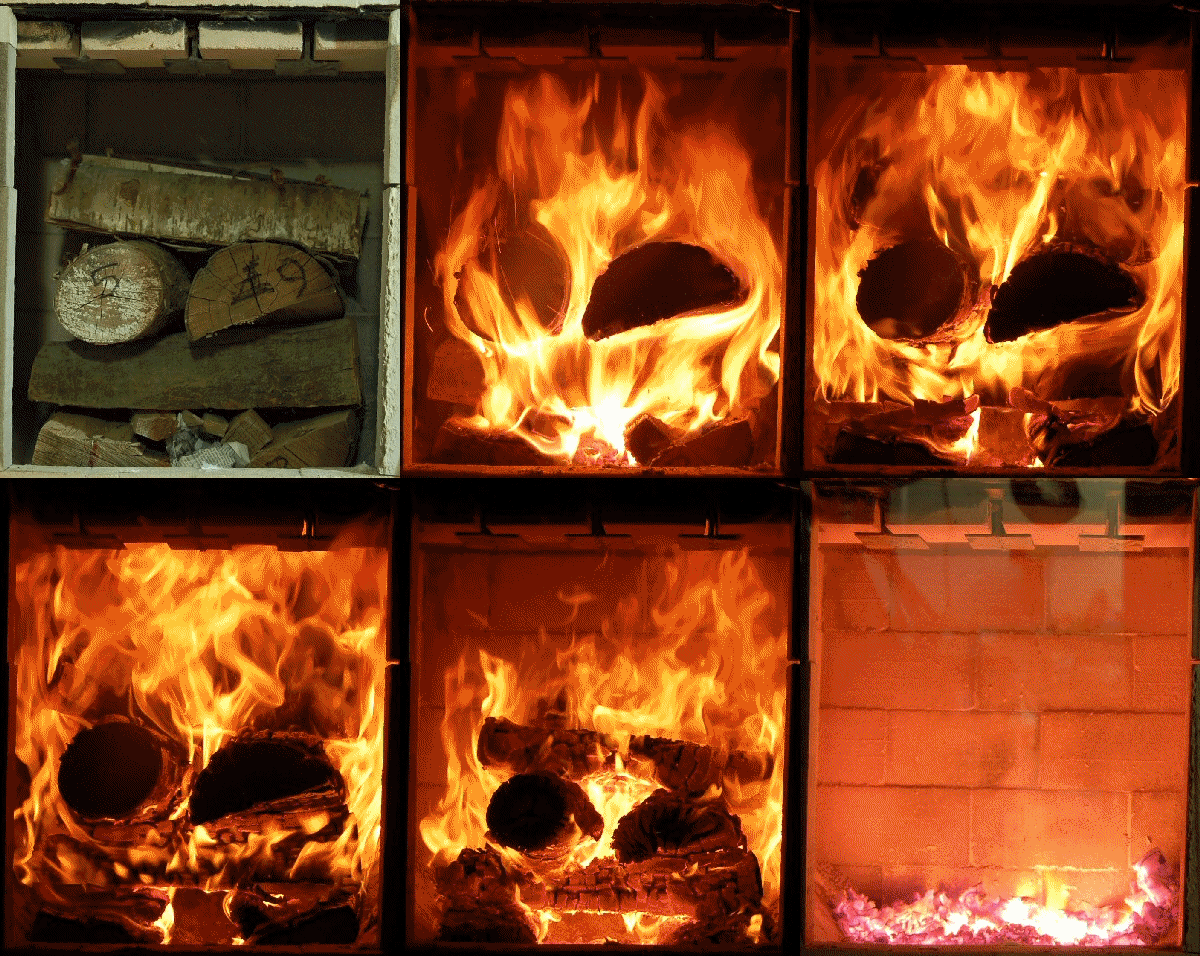
Mar 12/19:
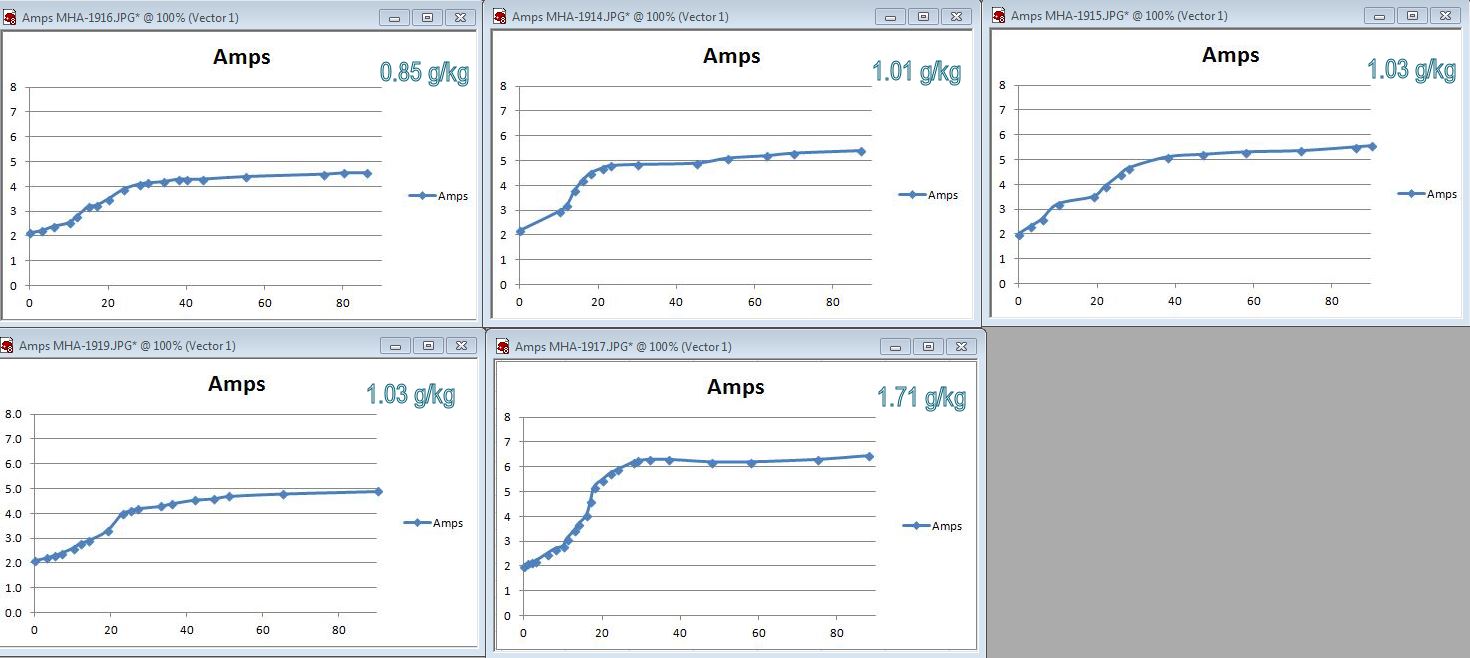
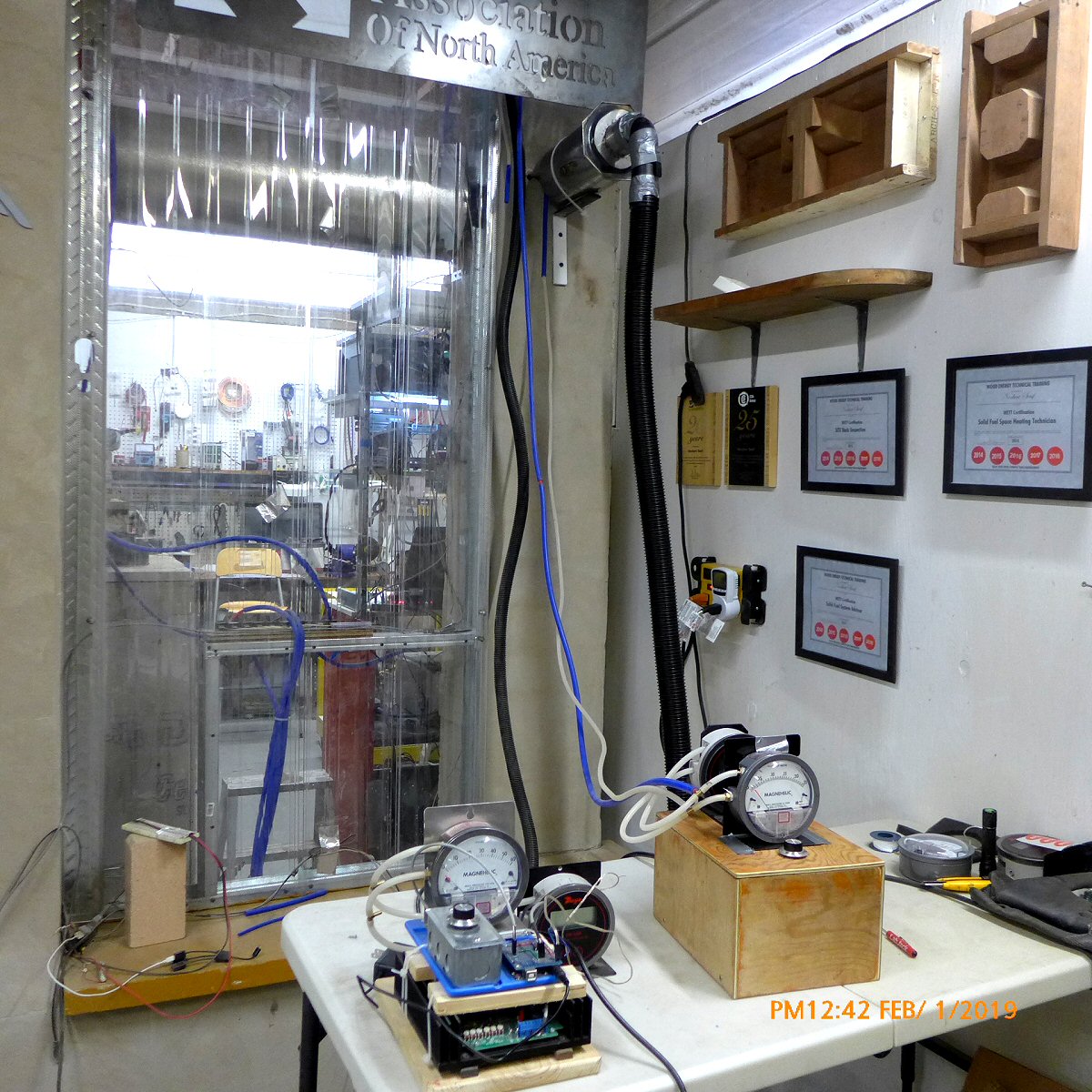
Plot of Condar vacuum power draw vs. PM, low to high for
5 runs.
The end points correlate reasonably well with the PM numbers in terms
of ranking.
February 27/19 - MHA-1919
Run #13 of a cold firebox test series. Heater fired
every 2nd day.
Random loading, white birch, log cabin stacking top
ignition. Cold firebox, cold fuel
Pieces loaded in order of increasing weight.
Looser stacking. 2331 stacking.
55.25 lbs including 2 lbs kindling
Estimated moisture 13%.
Pisla HTT 602 door, 22" wide
Austrian eco firebox, see http://www.heatkit.com/research/lopez-2014-03-01.html
1.03 g/kg Condar
11.05 g/kg CO
73.74% overall efficiency
February 25/19 - MHA-1918
Run #12 of a cold firebox test series. Heater fired
every 2nd day.
Random loading, oak, log cabin stacking top ignition. Cold firebox,
cold fuel
Pieces loaded in order of increasing weight.
Looser stacking. 23332 stacking.
65.1 lbs including 2 lbs kindling
Estimated moisture 13%.
Pisla HTT 602 door, 22" wide
Austrian eco firebox, see http://www.heatkit.com/research/lopez-2014-03-01.html
1.71 g/kg Condar
13.71 g/kg CO
76.48% overall efficiency
February 23/19 - MHA-1917
Run #11 of a cold firebox test series. Heater fired
every 2nd day.
Random loading, white birch, log cabin stacking top ignition. Cold
firebox, cold fuel
Pieces loaded in order of increasing weight.
Looser stacking. 23332 stacking.
56.3 lbs including 2 lbs kindling
Estimated moisture 13%.
Pisla HTT 602 door, 22" wide
Austrian eco firebox, see http://www.heatkit.com/research/lopez-2014-03-01.html
1.71 g/kg Condar
13.71 g/kg CO
76.48% overall efficiency
February 21/19 - MHA-1916
Run #10 of a cold firebox test series. Heater fired
every 2nd day.
Random loading, dry birch/oak mix, log cabin stacking, top ignition.
Cold firebox, cold fuel
Pieces loaded in order of increasing weight. 2344 stacking.
51.4 lbs including 2 lbs kindling
Estimated moisture 13%.
Tight stacking of the pile resulted in a somewhat slower start,
and bunching of the charcoal pile at the end.
Graph of Condar power draw vs. time looks like a good candidate to
provide real time PM data.
Pisla HTT 602 door, 22" wide
Austrian eco firebox, see http://www.heatkit.com/research/lopez-2014-03-01.html
0.85 g/kg Condar
7.33 g/kg CO
75.61% overall efficiency
February 19/19 - MHA-1915
Run #9 of a cold firebox test series. Heater fired every
2nd day.
Random loading, dry red oak, log cabin stacking, top ignition. Cold
firebox, cold fuel
Pieces loaded in order of increasing weight. 2344 stacking.
64.7 lbs including 2.1 lbs kindling
Estimated moisture 13%.
Run #9 of a cold firebox test series. Heater fired every 2nd day.
Fewer, larger kindling pieces and tight stacking of the pile resulted
in a slow start,
as can be seen in the stack temperature graph.
Small rise in PM. CO very low.
Pisla HTT 602 door, 22" wide
Austrian eco firebox, see http://www.heatkit.com/research/lopez-2014-03-01.html
1.03 g/kg Condar
8.81 g/kg CO
74.71% overall efficiency
February 17/19 - MHA-1914
Run #8 of a cold firebox test series. Heater fired every
2nd day.
Random loading, dry white birch, log cabin stacking, top ignition. Cold
firebox, cold fuel
Pieces loaded in order of increasing weight. 2344 stacking.
58 lbs (estimated) including 2.0 lbs kindling. Estimated moisture
13%.
Kindling stacked and ignited for a slower start, to ignite all the
kindling before the birch bark.
Low CO, but higher PM than an equivalent clean oak burn with the same
low CO, due to the birch bark.
(Compare with yesterday's oak burn, below)
Pisla HTT 602 door, 22" wide
Austrian eco firebox, see http://www.heatkit.com/research/lopez-2014-03-01.html
1.01 g/kg Condar
6.64 g/kg CO
74.94% overall efficiency
February 15/19 - MHA-1913
Run #7 of a cold firebox test series. Heater fired every
2nd day.
Random loading, very dry oak, log cabin stacking, top ignition. Cold
firebox, cold fuel
Pieces loaded in order of increasing weight. 2344 stacking.
61.7 lbs including 2.0 lbs kindling
Estimated moisture 13%.
Slow start, very staged, very clean.
Pisla HTT 602 door, 22" wide
Austrian eco firebox, see http://www.heatkit.com/research/lopez-2014-03-01.html
0.64 g/kg Condar
6.89 g/kg CO
77.27% overall efficiency
February 13/19 - MHA-1912
Run #6 of a cold firebox test series. Heater fired every
2nd day.
Random loading, white birch, log cabin stacking, top ignition. Cold
firebox.
Pieces loaded in order of increasing weight. 2344 stacking.
60.3 lbs including 2.0 lbs kindling
Estimated moisture 15%.
CO spike at the beginning, high PM from birch bark
burning at around 10 minute mark.
See sequence photo and lab notes.
Interesting comparison with previous run.
Demonstrates the greater
variability with a cold firebox, more sensitivity to initial
conditions, kindlling stacking, ignition sequence.
Pisla HTT 602 door, 22" wide
Austrian eco firebox, see http://www.heatkit.com/research/lopez-2014-03-01.html
2.01 g/kg Condar
12.10 g/kg CO
77.19% overall efficiency
February 11/19 - MHA-1911
Run #5 of a cold firebox test series. Heater fired every
2nd day.
Random loading, white birch, log cabin stacking, top ignition. Cold
firebox.
Pieces loaded in order of increasing weight. 23431 stacking.
57.9 lbs including 2.0 lbs kindling
Estimated moisture 15%.
Pisla HTT 602 door, 22" wide
Austrian eco firebox, see http://www.heatkit.com/research/lopez-2014-03-01.html
0.83 g/kg Condar
4.23 g/kg CO
76.15% overall efficiency (99.21% combustion efficiency)
Run #4 of a cold firebox test series. Heater fired every
2nd day.
Random loading, white birch, log cabin stacking, top ignition. Cold
firebox, cold fuel
Pieces loaded in order of increasing weight. 2344 stacking.
62.4 lbs including 2.0 lbs kindling
Estimated moisture 15%.
USB communication problem with Testo, gas data incomplete.
Dirty start, plugged filter in Condar, no filter change performed
This was the 8th full run using the new automated
Condar controller
Pisla HTT 602 door, 22" wide
Austrian eco firebox, see http://www.heatkit.com/research/lopez-2014-03-01.html
1.2 g/kg Condar (estimated)
16 g/kg CO (estimated)
72.5% overall efficiency (estimated)
Run #3 of a cold firebox test series. Heater fired every
2nd day.
Random loading, red oak, log cabin stacking, top ignition. Cold firebox.
Pieces loaded in order of increasing weight. 2344 stacking.
63.6 lbs including 2.0 lbs kindling
Estimated moisture 15%.
Pisla HTT 602 door, 22" wide
Austrian eco firebox, see http://www.heatkit.com/research/lopez-2014-03-01.html
1.18 g/kg Condar
19.86 g/kg CO
72.62% overall efficiency
Run #2 of a cold firebox test series. Heater fired every
2nd day.
Random loading, red oak, log cabin stacking, top ignition. Cold firebox.
Pieces loaded in order of increasing weight. 2344 stacking.
69.3 lbs including 2.0 lbs kindling
Estimated moisture 15%.
Pisla HTT 602 door, 22" wide
Austrian eco firebox, see http://www.heatkit.com/research/lopez-2014-03-01.html
0.96 g/kg Condar
11.55 g/kg CO
73.40% overall efficiency
First run of cold
firebox test series. Heater fired every 2nd day.
Random loading, red oak, log cabin stacking, top ignition.
Pieces loaded in order of increasing weight. 2344 stacking.
71.9 lbs including 2.0 lbs kindling
Estimated moisture 15%.
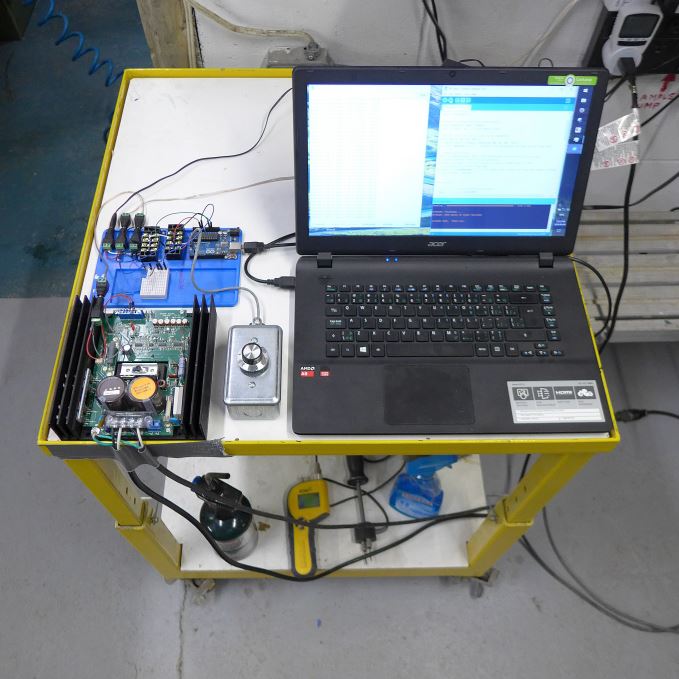
This is the first test that was fully automated - once the Condar and
Testo were set up
and turned on, there was no intervention until the Condar was turned
off at 90 minutes.
Pisla HTT 602 door, 22" wide
Austrian eco firebox, see http://www.heatkit.com/research/lopez-2014-03-01.html
0.99 g/kg Condar
8.12 g/kg CO
76.37% overall efficiency (values calculated at 90 minutes -
see full test page for values at 120 minutes) 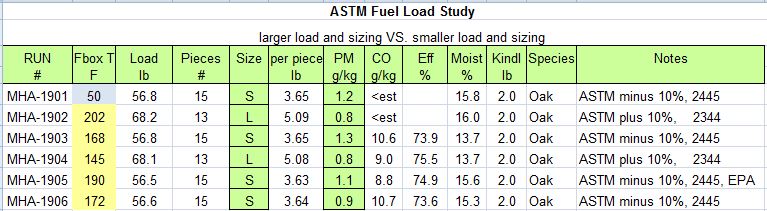
ASTM load minus 10%,
small wood, dry wood, warm heater
repeat of MHA-1905, with
chimney bleed closed
Red oak,l og cabin stacking, top ignition
56.8 lbs including 2.0 lbs kindling
13.7% moisture. 2445 stacking.
Pisla HTT 602 door, 22" wide
Austrian eco firebox, see http://www.heatkit.com/research/lopez-2014-03-01.html
0.9 g/kg Condar
10.70 g/kg CO
73.60% overall efficiency ASTM load minus 10%,
small wood, dry wood, warm heater
Red oak, log cabin stacking, top ignition
56.5 lbs including 2.0 lbs kindling
15.6% moisture. 2445 stacking.
Chimney
bleed open to simulate EPA test (16' (+/- 1') chimney height
terminating inside the room)
Pisla HTT 602 door, 22" wide
Austrian eco firebox, see http://www.heatkit.com/research/lopez-2014-03-01.html
1.09 g/kg Condar
8.80 g/kg CO
74.85% overall efficiency
ASTM load plus 10%,
large wood, dry wood, warm heater
Red oak, log cabin stacking, top ignition
68.1 lbs including 2.0 lbs kindling
13.7% moisture. 2344 stacking.
Pisla HTT 602 door, 22" wide
Austrian eco firebox, see http://www.heatkit.com/research/lopez-2014-03-01.html
0.80 g/kg Condar
9.02 g/kg CO
75.48% overall efficiency ASTM load minus 10%,
small wood, dry wood, warm heater
Red oak,l og cabin stacking, top ignition
56.8 lbs including 2.0 lbs kindling
13.7% moisture. 2445 stacking.
Pisla HTT 602 door, 22" wide
Austrian eco firebox, see http://www.heatkit.com/research/lopez-2014-03-01.html
This was first full
run of a full test using the new automated
Condar controller
1.28 g/kg PM (Condar)
10.59 g/kg CO
73.87% overall efficiency ASTM load + 10%, large
wood, dry wood, warm heater
Red oak, log cabin stacking, top ignition
68.2 lbs including 2.0 lbs kindling
16.0% moisture. 2344 stacking.
Pisla HTT 602 door, 22" wide
Austrian eco firebox, see http://www.heatkit.com/research/lopez-2014-03-01.html
ASTM load minus10%,
small wood, dry wood, cold heater
Red oak, log cabin stacking, top ignition
56.6 lbs including 2.0 lbs kindling
15.8% moisture. 2445 stacking.
Pisla HTT 602 door, 22" wide
Austrian eco firebox, see http://www.heatkit.com/research/lopez-2014-03-01.html
February 22/18 - MHA-1827
Heat
exchanger reconfigured from downdrafting parallel channels
to a serial channel.
Repeat
of standard 14 piece stacking from MHA-1801 - MHA-1816
Same wet weight, same kindling, different species, higher moisture
1 lb extra kindling.
Maple,
log cabin stacking, 2345 stacking. Top ignition
63.0 lbs including 3.0 lbs kindling
31.5% moisture. 2345 stacking.
Warm firebox 188F
Data
calculated at the standard 90 minute burn time.
0.99 g/kg PM (Condar)
12.54 g/kg CO
76.68% overall efficiency.
February 21/18 - MHA-1826
Heat
exchanger reconfigured from downdrafting parallel channels
to a serial channel.
Repeat
of standard 14 piece stacking from MHA-1801 - MHA-1816
Same wet weight, same kindling, different species, higher moisture
Maple,
log cabin stacking, 2345 stacking. Top ignition
62.0 lbs including 2.0 lbs kindling
30.8% moisture. 2345 stacking.
Warm firebox 187F.
Data
calculated at the standard 90 minute burn time. Data to 120 minutes is
available on request.
1.67 g/kg PM (Condar)
16.21 g/kg CO
77.10% overall efficiency.
February 20/18 - MHA-1825
Heat
exchanger reconfigured from downdrafting parallel channels
to a serial channel.
Repeat
of standard 14 piece stacking from MHA-1801 - MHA-1816
Same wet weight, same kindling, different species, higher moisture
Maple,
log cabin stacking, 2345 stacking. Top ignition
62.0 lbs including 2.0 lbs kindling
30.6% moisture. 2345 stacking.
Warm firebox 165F
Data
calculated at the standard 90 minute burn time. Data is available on
request to 120 minutes.
1.51 g/kg PM (Condar)
21.50 g/kg CO
76.14% overall efficiency.
February 19/18 - MHA-1824
Heat
exchanger reconfigured from downdrafting parallel channels
to a serial channel.
Repeat
of standard 14 piece stacking from MHA-1801 - MHA-1816
Same wet weight, same kindling, different species, higher moisture
Maple,
log cabin stacking, 2345 stacking. Top ignition
62.0 lbs including 2.0 lbs kindling
33.6% moisture. 2345 stacking.
Cold firebox 64F
Data
calculated at the standard 90 minute burn time and also at 120 minutes
2.30 g/kg PM (Condar)
19.58 g/kg CO
77.73% overall efficiency.
February 16/18 - MHA-1823
Heat
exchanger reconfigured from downdrafting parallel channels
to a serial channel.
Repeat
of standard 14 piece stacking from MHA-1801 - MHA-1816
Same wet weight, same kindling, different species, higher moisture
Maple,
log cabin stacking, 2345 stacking. Top ignition
62.0 lbs including 2.0 lbs kindling
30.9% moisture. 2345 stacking.
Warm firebox, 184F
1.68 g/kg PM (Condar)
14.61 g/kg CO
76.76% overall efficiency.
February 15/18 - MHA-1822
Heat
exchanger reconfigured from downdrafting parallel channels
to a serial channel.
Repeat
of standard 14 piece stacking from MHA-1801 - MHA-1816
Same wet weight, same kindling, different species, higher moisture
Maple,
log cabin stacking, 2345 stacking. Top ignition
62.0 lbs including 2.0 lbs kindling
31.9% moisture. 2345 stacking.
Warm firebox, 249F
0.95 g/kg PM (Condar)
13.61 g/kg CO
77.14% overall efficiency.
February 14/18 - MHA-1821
Heat
exchanger reconfigured from downdraftting parallel channels
to channels in series.
Experimental
stacking according to ASTM E2780 "high burn rate"
In ASTM testing, the load is intended to be ignited from a hot coal bed.
In this modification, pieces on the top row are split in half, and
ignited with kindling placed on top
Red
oak, log cabin stacking, 234 stacking. Top ignition
60.5 lbs including 3.0 lbs kindling
21.5% moisture. 234 stacking.
Warm firebox, 230F
Significant drop in PM with warmer firebox and reduced kindling weight.
0.80 g/kg PM (Condar)
14.91 g/kg CO
75.81% overall efficiency.
February 13/18 - MHA-1820
Heat
exchanger reconfigured from downdraftting parallel channels
to channels in series.
Experimental stacking
according to ASTM E2780 "high burn rate"
In ASTM testing, the load is intended to be ignited from a hot coal bed.
In this modification, pieces on the top row are split in half, and
ignited with kindling placed on top
Red oak, log cabin
stacking, 234 stacking. Top ignition
61.5 lbs including 4.0 lbs kindling
22.2% moisture. 234 stacking.
Warm firebox, 133F
Opacity
measurment added to data acquisition system.
1.31 g/kg PM (Condar)
16.12 g/kg CO
75.39% overall
efficiency
February 12/18 - MHA-1819
Heat
exchanger reconfigured from downdraftting parallel channels
to channels in series.
Experimental stacking
according to ASTM E2780 "high burn rate"
In ASTM testing, the load is intended to be ignited from a hot coal bed.
In this modification, pieces on the top row are split in half, and
ignited with kindling placed on top
Red oak, log cabin
stacking, 234 stacking. Top ignition
61.5 lbs including 4.0 lbs kindling
23.1% moisture.
Firebox
was cold. Based on last run (MHA-1818),
kindling was doubled to 4 lbs.
Opacity
measurment added to data acquisition system.
1.70 g/kg PM (Condar)
29.73 g/kg CO
75.28% overall efficiency
Heat
exchanger reconfigured from downdraftting parallel channels
to channels in series.
Experimental stacking
according to ASTM E2780 "high burn rate"
In ASTM testing, the load is intended to be ignited from a hot coal bed.
In this modification, pieces on the top row are split in half, and
ignited with kindling placed on top
Red oak, log cabin
stacking, 234 stacking. Top ignition
60.5 lbs including 2.0 lbs kindling
20.3% moisture. 234 stacking.
1.29 g/kg PM (Condar)
23.10 g/kg CO
73.09% overall efficiency
February 8/18 - MHA-1817
Calibration run for
new opacity instrumentation.
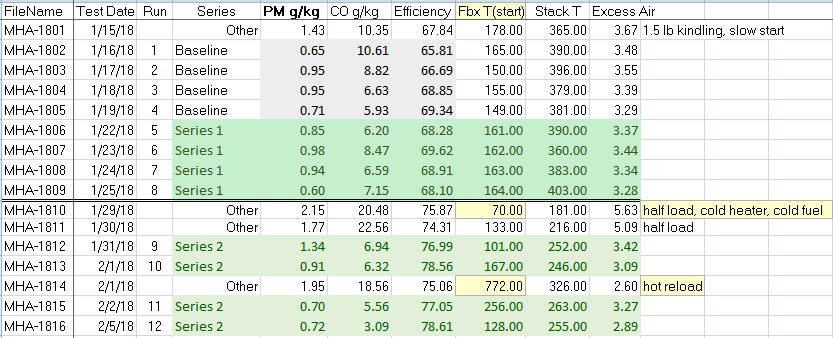
Results Summary. Temperatures are in Fahrenheit. Study
description
Heat
exchanger reconfigured from downdraftting parallel channels
to channels in series.
Fourth run of
"Substantially Similar" study with reconfigured heat-exchanger
Run #12 of "Substantially Similar" study
Red oak, log cabin stacking, top ignition
62.0 lbs including 2.0 lbs kindling
23.2% moisture. 2345 stacking.
0.72 g/kg PM (Condar)
3.09 g/kg CO
78.61% overall efficiency
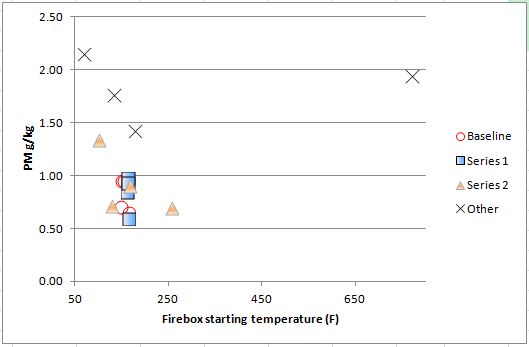
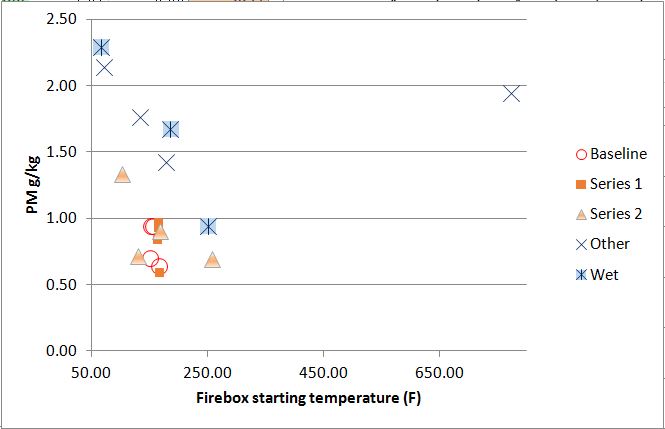
Result
of 16 runs
Starting with baseline runs at MHA-1802, followed by chimney
change to EPA specs (Series 1)
followed by heat exchanger change (Series 2)
This graph demonstrated that the starting temperature of the firebox
walls has an effect on PM
Heat
exchanger reconfigured from downdraftting parallel channels
to channels in series.
Third run of
"Substantially Similar" study with reconfigured heat-exchanger
Run #12 of "Substantially Similar" study
Red oak, log cabin stacking, top ignition
62.0 lbs including 2.0 lbs kindling
23.2% moisture. 2345 stacking.
Warmer firebox to start, due to double firing yesterday.
0.70 g/kg PM (Condar)
5.56 g/kg CO
76.71% overall efficiency
Heat
exchanger reconfigured from downdraftting parallel channels
to channels in series.
Hot reload with full
load, at end of MHA-1813, below
Red oak, log cabin stacking, top ignition
60.0 lbs, no kindling. Reload onto hot coal bed.
21.6% moisture. 2345 stacking.
1.95 g/kg PM (Condar)
18.56 g/kg CO
74.28% overall efficiency
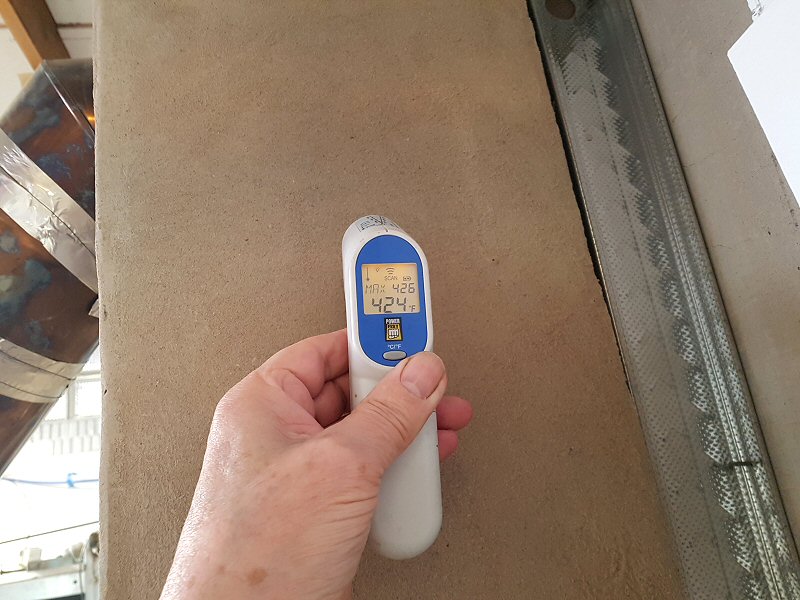
Surface temperature immediately after the connecting pipe from the
firebox, after 122 lbs of wood. Heat
exchanger reconfigured from downdraftting parallel channels
to channels in series.
Second run of
"Substantially Similar" study with reconfigured heat-exchanger
Run #11 of "Substantially Similar" study
Red oak, log cabin stacking, top ignition
62.0 lbs including 2.0 lbs kindling
21.6% moisture. 2345 stacking.
0.91 g/kg PM (Condar)
6.32 g/kg CO
78.41% overall efficiency
Heat
exchanger reconfigured from downdraftting parallel channels
to channels in series.
First run of
"Substantially Similar" study with reconfigured heat-exchanger
Run #10 of "Substantially Similar" study
Red oak, log cabin stacking, top ignition
62.0 lbs including 2.0 lbs kindling
22.1% moisture. 2345 stacking.
1.34 g/kg PM (Condar)
6.94 g/kg CO
76.60% overall efficiency
Heat
exchanger reconfigured from downdraftting parallel channels
to channels in series.
Red oak, small fuel,
half load
Repeat of MHA-1810 except warm heater, warm fuel
Log cabin stacking, top ignition
34.0 lbs including 2.0 lbs kindling
21.3% moisture.
1.77 g/kg PM (Condar)
22.56 g/kg CO
73.22% overall efficiency
Heat
exchanger reconfigured from downdraftting parallel channels
to channels in series.
Red oak, small fuel,
half load
Cold heater, cold fuel
Log cabin stacking, top ignition
34.0 lbs including 2.0 lbs kindling
21.2% moisture.
2.15 g/kg PM (Condar)
20.85 g/kg CO
75.35% overall efficiency
Run #9 of a
"Substantially Similar" study for possible use in certifying factory
made heaters,
to allow laboratory testing on one model to apply
also to heat exchanger variations on that model.
Fourth of set of four
repeats, with the chimney modified to conform to EPA laboratory testing
conditions.
Red oak, log cabin
stacking, top ignition
62.0 lbs including 2.0 lbs kindling
21.5% moisture. 2345 stacking.
0.60 g/kg PM (Condar)
7.15 g/kg CO
68.00% overall efficiency
Run #8 of a
"Substantially Similar" study for possible use in certifying factory
made heaters,
to allow laboratory testing on one model to apply
also to heat exchanger variations on that model.
Third of set of four
repeats, with the chimney modified to conform to EPA laboratory testing
conditions.
Red oak, log cabin
stacking, top ignition
62.0 lbs including 2.0 lbs kindling
21.7% moisture. 2345 stacking.
0.94 g/kg PM (Condar)
6.59 g/kg CO
68.82% overall efficiency
Run #7 of a
"Substantially Similar" study for possible use in certifying factory
made heaters,
to allow laboratory testing on one model to apply
also to heat exchanger variations on that model.
Second of set of four
repeats, with the chimney modified to conform to EPA laboratory testing
conditions.
Red oak, log cabin
stacking, top ignition
62.0 lbs including 2.0 lbs kindling
22.8% moisture. 2345 stacking.
0.98 g/kg PM (Condar)
8.47 g/kg CO
69.60% overall efficiency
Run #6 of a
"Substantially Similar" study for possible use in certifying factory
made heaters,
to allow laboratory testing on one model to apply
also to heat exchanger variations on that model.
First of set of four
repeats, with the chimney modified to conform to EPA laboratory testing
conditions.
Red oak, log cabin
stacking, top ignition
62.0 lbs including 2.0 lbs kindling
22.9% moisture. 2345 stacking.
0.85 g/kg PM (Condar)
6.20 g/kg CO
68.28% overall efficiency
Run #5 of a
"Substantially Similar" study for possible use in certifying factory
made heaters,
to allow laboratory testing on one model to apply
also to heat exchanger variations on that model.
Red oak, log cabin
stacking, top ignition
62.0 lbs including 2.0 lbs kindling
21.9% moisture. 2345 stacking.
0.71 g/kg PM (Condar)
5.93 g/kg CO
69.34% overall efficiency
Run #4 of a
"Substantially Similar" study for possible use in certifying factory
made heaters,
to allow laboratory testing on one model to apply
also to heat exchanger variations on that model.
Red oak, log cabin
stacking, top ignition
62.0 lbs including 2.0 lbs kindling
21.1% moisture. 2345 stacking.
0.95 g/kg PM (Condar)
6.63 g/kg CO
68.85% overall efficiency
Run #3 of a
"Substantially Similar" study for possible use in certifying factory
made heaters,
to allow laboratory testing on one model to apply
also to heat exchanger variations on that model.
Red oak, log cabin
stacking, top ignition
62.0 lbs including 2.0 lbs kindling
21.3% moisture. 2345 stacking.
0.95 g/kg PM (Condar)
8.82 g/kg CO
66.69% overall efficiency
Run #2 of a
"Substantially Similar" study for possible use in certifying factory
made heaters,
to allow laboratory testing on one model to apply
also to heat exchanger variations on that model.
Red oak, log cabin
stacking, top ignition
62.0 lbs including 2.0 lbs kindling
19.9% moisture. 2345 stacking.
0.65 g/kg PM (Condar)
10.61 g/kg CO
65.81% overall efficiency
Run #1 of a
"Substantially Similar" study for possible use in certifying factory
made heaters,
to allow laboratory testing on one model to apply
also to heat exchanger variations on that model.
Red oak, log cabin
stacking, top ignition
Log cabin stacking, top ignition
61.5 lbs including 1.5 lbs kindling
21.7% moisture. 2344 stacking.
1.43 g/kg PM (Condar)
10.351 g/kg CO
67.84% overall efficiency
Condar
Field Testing Workshop at
2017 MHA Meeting
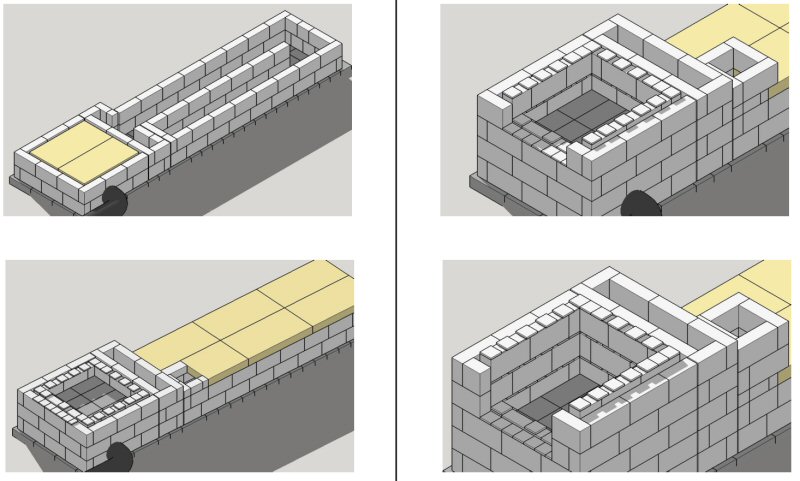
Manufactured
J-Loop Heater Testing at Hearth Lab
Solutions, Randolph VT
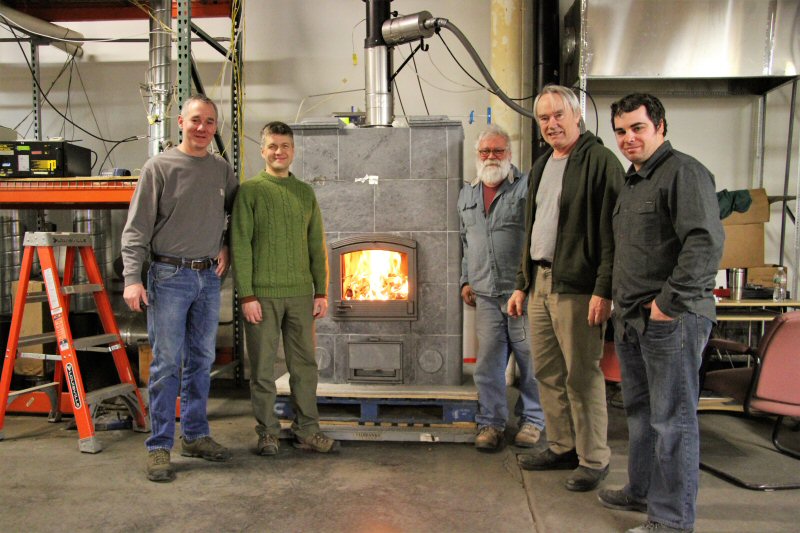
Left
to right: Mark Champion, Boris Kukolj, Chris Prior, Norbert Senf,
Jean-Francois Vachon
Photo credit: Mark
Seymour
MHA
Research Heater, 2017
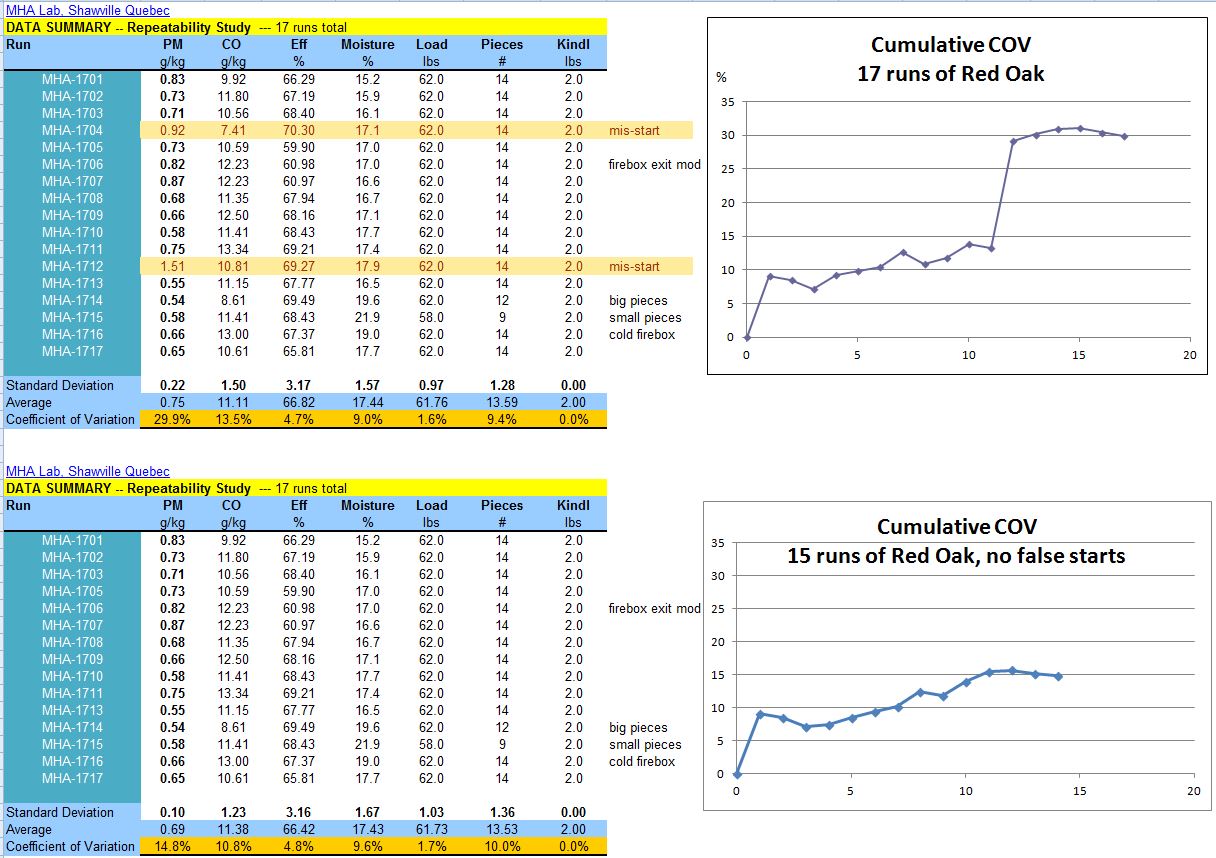
Run #16 (final run) of
a repeatability study with a new test fueling protocol under
development.
Red oak, seasoned 3
years
Log cabin stacking, top ignition
62.0 lbs including 2.0 lbs kindling
17.7% moisture. 2345 stacking.
0.65 g/kg PM (Condar)
10.61 g/kg CO
65.81% overall efficiency
Red oak, seasoned 3
years
Log cabin stacking, top ignition
62.0 lbs including 2.0 lbs kindling
19.0% moisture.
Cold firebox. 2345 stacking.
0.66 g/kg PM (Condar)
13.00 g/kg CO
67.37% overall efficiency
Run #14 of a
repeatability study with a new test fueling protocol under deverlopment.
Red oak, seasoned 3
years
Log cabin stacking, top ignition
58.0 lbs including 2.0 lbs kindling
21.9% moisture. Small pieces within the 4"-6" range. See fuel stack
photo.
0.58 g/kg PM (Condar)
11.41 g/kg CO
68.43% overall efficiency
Run #13 of a
repeatability study with a new test fueling protocol under deverlopment.
Red oak, seasoned 3
years
Log cabin stacking, top ignition
62.0 lbs including 2.0 lbs kindling
19.6% moisture. 2334 stacking, see fuel photo
0.54 g/kg PM (Condar)
8.61 g/kg CO
69.49% overall efficiency
Run #12 of a
repeatability study with a new test fueling protocol under deverlopment.
Red oak, seasoned 3
years
Log cabin stacking, top ignition
62.0 lbs including 2.0 lbs kindling
16.5% moisture. Loads MHA-1701 to MHA-1731 were stacked 2345
0.55 g/kg PM (Condar)
11.15 g/kg CO
67.77% overall efficiency
Run #11 of a
repeatability study with a new test fueling protocol under deverlopment.
Red oak, seasoned 3
years
Log cabin stacking, top ignition
62.0 lbs including 2.0 lbs kindling
17.9% moisture. 2345 stacking
False start - see gas graph
1.51 g/kg PM (Condar)
10.081 g/kg CO
69.27% overall efficiency
Run #10 of a
repeatability study with a new test fueling protocol under deverlopment.
Red oak, seasoned 3
years
Log cabin stacking, top ignition
62.0 lbs including 2.0 lbs kindling
17.4% moisture. 2345 stacking
0.75 g/kg PM (Condar)
13.34 g/kg CO
69.21% overall efficiency
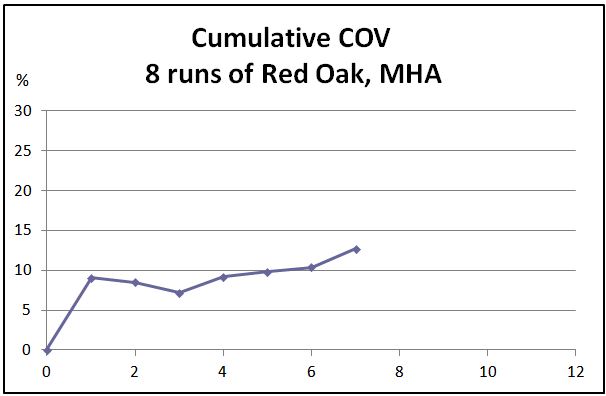
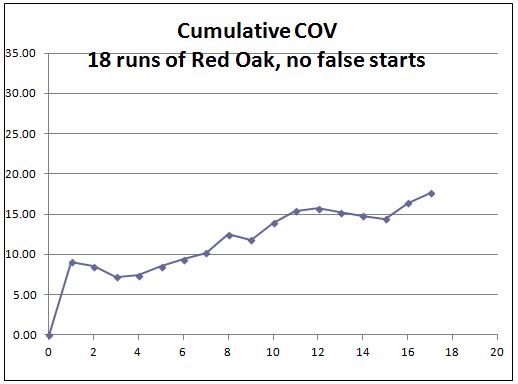
Cumulative coefficient of variability (repeatability)
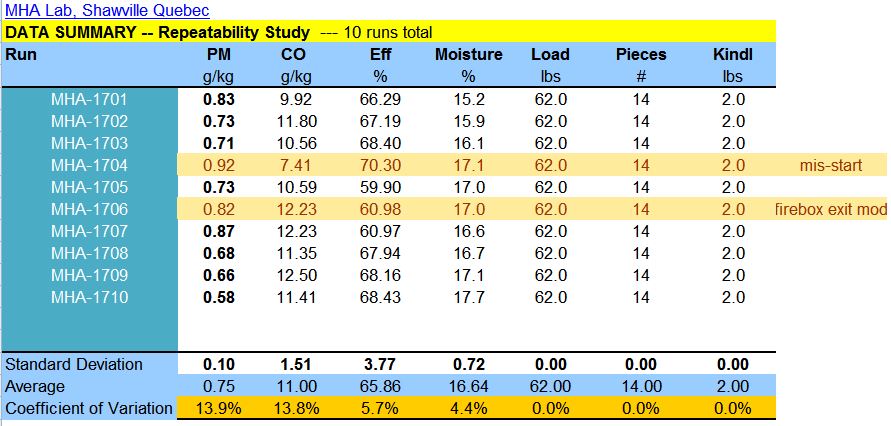
Compare with 2016 results with white birch and side ignition, below
(scroll down)
Run #9 of a
repeatability study with a new test fueling protocol under deverlopment.
Red oak, seasoned 3
years
Log cabin stacking, top ignition
62.0 lbs including 2.0 lbs kindling
17.7% moisture. 2345 stacking
0.58 g/kg PM (Condar)
11.41 g/kg CO
68.43% overall efficiency
Eighth run of
repeatability study with a new test fueling protocol under deverlopment.
Red oak, seasoned 3
years
Log cabin stacking, top ignition
62.0 lbs including 2.0 lbs kindling
17.1% moisture. 2345 stacking
0.66 g/kg PM (Condar)
12.50 g/kg CO
68.16% overall efficiency
Seventh run of
repeatability study with a new test fueling protocol under deverlopment.
Red oak, seasoned 3
years
Log cabin stacking, top ignition
62.0 lbs including 2.0 lbs kindling
16.7% moisture. 2345 stacking
0.68 g/kg PM (Condar)
11.35 g/kg CO
67.94% overall efficiency
Sixth run of
repeatability study with a new test fueling protocol under deverlopment.
Red oak, seasoned 3
years
Log cabin stacking, top ignition
62.0 lbs including 2.0 lbs kindling
16.6% moisture. 2345 stacking
0.87 g/kg PM (Condar)
12.23 g/kg CO
60.97% overall efficiency
Repeat run of
MHA-1705, except heater exit modification (see link for details)
Red oak, seasoned 3
years
Log cabin stacking, top ignition
62.0 lbs including 2.0 lbs kindling
17.0% moisture. 2345 stacking
0.82 g/kg PM (Condar)
12.23 g/kg CO
60.98% overall efficiency
Fifth run of a
repeatability study with a new test fueling protocol under development
Red oak, seasoned 3
years
Log cabin stacking, top ignition
62.0 lbs including 2.0 lbs kindling
17.0% moisture. 2345 stacking
0.73 g/kg PM (Condar)
10.59 g/kg CO
59.90% overall efficiency
Fourth run of a
repeatability study with a new test fueling protocol under development
Red oak, seasoned 3
years
Log cabin stacking, top ignition
62.0 lbs including 2.0 lbs kindling
17.1% moisture. 2345 stacking
0.92 g/kg PM (Condar)
7.41 g/kg CO
70.30% overall efficiency
Third run of a
repeatability study with a new test fueling protocol under development
Red oak, seasoned 3
years
Log cabin stacking, top ignition
62.0 lbs including 2.0 lbs kindling
16.1% moisture. 2345 stacking
0.71 g/kg PM (Condar)
10.56 g/kg CO
68.40% overall efficiency
Second run of a
repeatability study with a new test fueling protocol under development
Red oak, seasoned 3
years
Log cabin stacking, top ignition
62.0 lbs including 2.0 lbs kindling
15.9% moisture. 2345 stacking
0.73 g/kg PM (Condar)
11.80 g/kg CO
67.19% overall efficiency
First run of a
repeatability study with a new test fueling protocol under development
Red oak, seasoned 3
years
Log cabin stacking, top ignition
62.0 lbs including 2.0 lbs kindling
15.2% moisture. 2345 stacking
0.83 g/kg PM (Condar)
9.92 g/kg CO
66.29% overall efficiency
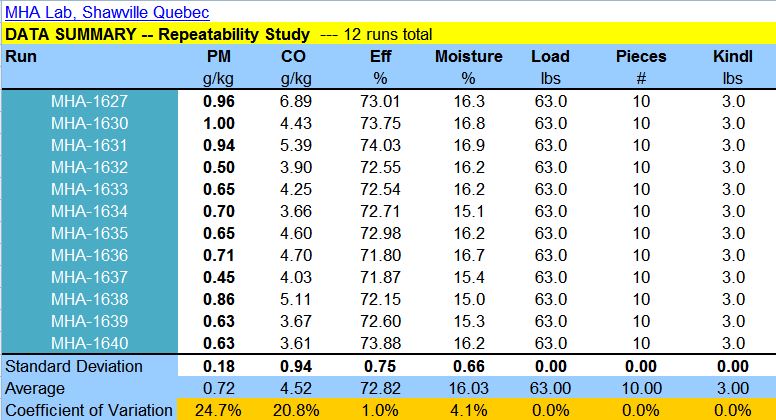
Repeat of 1627, all
birch.
Extra test #5 of matched
load series to investigate PM repeatability with cordwood
Log cabin stacking, side ignition,
63.0 lbs including 3.0 lbs kindling
16.2% moisture.
Last test of this series.
0.63 g/kg PM (Condar)
3.61 g/kg CO
73.88% overall efficiency
Repeat of 1627, all
birch.
Extra test #4 of matched
load series to investigate PM repeatability with cordwood
Log cabin stacking, side ignition,
63.0 lbs including 3.0 lbs kindling
15.3% moisture.
0.63 g/kg PM (Condar)
3.67 g/kg CO
72.60% overall efficiency
Repeat of 1627, all
birch.
Extra test #3 of matched
load series to investigate PM repeatability with cordwood
Log cabin stacking, side ignition,
63.0 lbs including 3.0 lbs kindling
15.0% moisture.
0.86 g/kg PM (Condar)
5.11 g/kg CO
72.15% overall efficiency
Repeat of 1627, all
birch.
Extra test #2 of matched
load series to investigate PM repeatability with cordwood
Log cabin stacking, side ignition,
63.0 lbs including 3.0 lbs kindling
15.4% moisture.
0.45 g/kg PM (Condar)
4.03 g/kg CO
71.87% overall efficiency
Repeat of 1627, all
birch.
Extra test #1 of matched
load series to investigate PM repeatability with cordwood
Log cabin stacking, side ignition,
63.0 lbs including 3.0 lbs kindling
16.7% moisture.
0.71 g/kg PM (Condar)
4.70 g/kg CO
71.80% overall efficiency
Repeat of 1627, all
birch.
Sixth of a six matched
load series to investigate PM repeatability with cordwood
Log cabin stacking, side ignition,
63.0 lbs including 3.0 lbs kindling
16.2% moisture.
0.65 g/kg PM (Condar)
4.60 g/kg CO
72.98% overall efficiency
Repeat of 1627, all
birch.
Fifth of a six matched
load series to investigate PM repeatability with cordwood
Log cabin stacking, side ignition,
63.0 lbs including 3.0 lbs kindling
15.1% moisture
0.70 g/kg PM (Condar)
3.66 g/kg CO
72.71% overall efficiency
Repeat of 1627, all
birch.
Fourth of a six matched
load series to investigate PM repeatability with cordwood
Log cabin stacking, side ignition,
63.0 lbs including 3.0 lbs kindling
16.2% moisture
0.65 g/kg PM (Condar)
4.25 g/kg CO
72.54% overall efficiency
Repeat of 1627, all
birch.
Third of a six matched
load series to investigate PM repeatability with cordwood
Log cabin stacking, side ignition,
63.0 lbs including 3.0 lbs kindling
16.2% moisture.
0.50 g/kg PM (Condar)
3.90 g/kg CO
72.55% overall efficiency
Repeat of 1627, all
birch.
Second of a six matched
load series to investigate PM repeatability with cordwood
Log cabin stacking, side ignition,
63.0 lbs including 3.0 lbs kindling
16.9% moisture.
0.94 g/kg PM (Condar)
5.39 g/kg CO
74.03% overall efficiency
Repeat of 1627, all
birch.
First of a six matched
load test series to investigate PM repeatability with cordwood
Log cabin stacking, side ignition,
63.0 lbs including 3.0 lbs kindling
16.8% moisture.
Baffle supports opened
up. See MHA-1625
Air slots in firebox unblocked, except for top course (25% restriction)
1.00 g/kg PM (Condar)
4.43 g/kg CO
73.75% overall efficiency
Repeat of 1626, all
oak, except all pieces split in half (20 pieces total instead of 10)
Log cabin stacking, side ignition,
63.0 lbs including 3.0 lbs kindling
20.6% moisture.
Baffle supports opened
up. See MHA-1625
Air slots in firebox unblocked, except for top course (25% restriction)
0.52 g/kg PM (Condar)
9.64 g/kg CO
73.02% overall efficiency
Repeat of 1627, except
cold firebox
Log cabin stacking, side ignition,
63.0 lbs including 3.0 lbs kindling
16.3% moisture.
Baffle supports opened
up. See MHA-1625
Air slots in firebox unblocked, except for top course (25% restriction)
0.58 g/kg PM (Condar)
5.03 g/kg CO
75.50% overall efficiency
Repeat of 1626, except
fuel is all white birch instead of all oak
Log cabin stacking, side ignition,
63.0 lbs including 3.0 lbs kindling
16.3% moisture.
Baffle supports opened
up. See MHA-1625
Air slots in firebox unblocked, except for top course (25% restriction)
Note the CO spike at
the beginning, and then the run of extremely low CO, well below 100 ppm.
0.96 g/kg PM (Condar)
6.89 g/kg CO
73.01% overall efficiency
Repeat of 1625, except
fuel is all oak instead of birch/oak mix
Log cabin stacking, side ignition,
63.0 lbs including 3.0 lbs kindling
20.7% moisture.
Baffle supports opened
up. See MHA-1625
Air slots in firebox unblocked, except for top course (25% restriction)
0.62 g/kg PM (Condar)
7.87 g/kg CO
72.57% overall efficiency
Birch/oak mix
Log cabin stacking, side ignition,
63.0 lbs including 3.0 lbs kindling
17.7% moisture.
Baffle supports opened
up. See photo below.
Air slots in firebox unblocked, except for top course (25% restriction)
See MHA-1623
for other modifications.
1.10 g/kg PM (Condar)
5.38 g/kg CO
76.14% overall efficiency
Birch/oak mix
Log cabin stacking, side ignition,
63.0 lbs including 3.0 lbs kindling
17.4% moisture.
Baffle added, see
photos.
Air slots in firebox unblocked, except for top course (25% restriction)
See MHA-1623
for other modifications.
1.29 g/kg PM (Condar)
9.14 g/kg CO
73.54% overall efficiency
Hardwood mix
Log cabin stacking, side ignition, cold heater
63.0 lbs including 3.0 lbs kindling
16.2% moisture.
Air slots in firebox
unblocked, except for top course
Chimney extension into firebox removed, see photo in MHA-1616
1.40 g/kg PM (Condar)
10.07 g/kg CO
71.51% overall efficiency
Hardwood mix
Log cabin stacking, side ignition
63.0 lbs including 3.0 lbs kindling
17.1% moisture.
Air slots in firebox reduced approx 75%
Chimney extension into firebox removed, see photo in MHA-1616
0.51 g/kg PM (Condar)
4.94 g/kg CO
70.30% overall efficiency
Hardwood mix
Log cabin stacking, side ignition
63.0 lbs including 3.0 lbs kindling
17.1% moisture.
Repeat of MHA-1621
Air slots in firebox
reduced approx 75%
Firebox exit dropped with 12" of ss liner, see photo in MHA-1616
0.55 g/kg PM (Condar)
6.179 g/kg CO
69.72% overall efficiency
Hardwood mix
Log cabin stacking, side ignition
63.0 lbs including 3.0 lbs kindling
16.5% moisture.
Testo leak. Gas data estimated from MHA1618
Firebox top modified
to raise exit. See http://heatkit.com/research/MHA%20research%20heater%20mods%2002.htm
Firebox exit dropped with 12" of ss liner, see in
MHA-1616
Air slots in firebox reduced approx 75%
0.81 g/kg PM (Condar)
6.14 g/kg CO
71.80% overall efficiency
Hardwood mix
Log cabin stacking, top ignition
63.0 lbs including 3.0 lbs kindling
14.6% moisture.
Firebox top modified
to raise exit. See http://heatkit.com/research/MHA%20research%20heater%20mods%2002.htm
Firebox exit dropped with 12" of ss liner, see in
MHA-1616
Air slots in firebox reduced approx 75%
0.87 g/kg PM (Condar)
5.84 g/kg CO
69.38% overall efficiency
February 29/16 - MHA-1618
Hardwood mix
Log cabin stacking, side ignition, cold firebox
63.0 lbs including 3.0 lbs kindling
17.6% moisture.
Firebox top modified
to raise exit. See http://heatkit.com/research/MHA%20research%20heater%20mods%2002.htm
Firebox exit dropped with 12" of ss liner, see in
MHA-1616
Air slots in firebox reduced approx 75%
0.67 g/kg PM (Condar)
6.33 g/kg CO
73.67% overall efficiency
February 26/16 - MHA-1617
Hardwood mix
Log cabin stacking, top ignition
63.0 lbs including 3.0 lbs kindling
16.2% moisture.
0.52 g/kg PM (Condar)
5.47 g/kg CO
70.52% overall efficiency
February 25/16 - MHA-1616
Hardwood mix
Log cabin stacking, side ignition
63.0 lbs including 3.0 lbs kindling
16.4% moisture.
Firebox top modified
to raise exit. See http://heatkit.com/research/MHA%20research%20heater%20mods%2002.htm
Firebox exit dropped with 12" of ss liner, see photo
Air slots in firebox reduced approx 50%
0.64 g/kg PM (Condar)
4.28 g/kg CO
73.56% overall efficiency
February 24/16 - MHA-1615
Hardwood mix
Log cabin stacking, side ignition
63.0 lbs including 3.0 lbs kindling
17.5% moisture.
Firebox top modified
to raise exit. See http://heatkit.com/research/MHA%20research%20heater%20mods%2002.htm
Air slots in firebox reduced approx 50%
0.84 g/kg PM (Condar)
10.0 g/kg CO
70.85% overall efficiency
February 23/16 - MHA-1614
Hardwood mix
Log cabin stacking, side ignition
63.0 lbs including 3.0 lbs kindling
17.2% moisture.
O2 sensor issue at end. O2 estimated from previous run.
Firebox top modified
to raise exit. See http://heatkit.com/research/MHA%20research%20heater%20mods%2002.htm
Air slots in firebox reduced approx 50%
0.61 g/kg PM (Condar)
5.51 g/kg CO
69.31% overall efficiency
February 22/16 - MHA-1613
Hardwood mix
Log cabin stacking, side ignition
63.8 lbs including 3.75 lbs kindling
15.6% moisture.
Firebox top modified
to raise exit. See http://heatkit.com/research/MHA%20research%20heater%20mods%2002.htm
Air slots in firebox reduced approx 50%
0.51 g/kg PM (Condar)
6.99 g/kg CO
68.12% overall efficiency
February 19/16 - MHA-1612
Hardwood mix
Vertical stacking.
61.3 lbs including 1.3 lbs kindling
15.8% moisture.
Firebox top modified
to raise exit. See http://heatkit.com/research/MHA%20research%20heater%20mods%2002.htm
Air slots in firebox reduced approx 50%
0.92 g/kg PM (Condar)
11.31 g/kg CO
70.67% overall efficiency
February 18/16 - MHA-1611
Hardwood mix
Vertical stacking.
61.3 lbs including 1.3 lbs kindling
15.8% moisture.
Firebox top modified
to raise exit. See http://heatkit.com/research/MHA%20research%20heater%20mods%2002.htm
Air wide open. High
stack temperatures.
Next test will reduce the air slots in the firebox.
0.55 g/kg PM (Condar)
9.27 g/kg CO
67.27% overall efficiency
February 17/16 - MHA-1610
Hardwood mix
Vertical stacking.
61.3 lbs including 1.3 lbs kindling
16.4% moisture.
Firebox top modified
to raise exit. See http://heatkit.com/research/MHA%20research%20heater%20mods%2002.htm
Testo problem, no gas
values.
February 16/16 - MHA-1609
Hardwood mix
Vertical stacking.
61.3 lbs including 1.3 lbs kindling
15.8% moisture.
Firebox top modified
to raise exit. See http://heatkit.com/research/MHA%20research%20heater%20mods%2002.htm
1.26 g/kg PM (Condar)
10.85 g/kg CO
63.29% overall efficiency
February 12/16 - MHA-1608
Hardwood mix
Horizontal stacking with side ignition
62.0 lbs including 1.3 lbs kindling
17.0% moisture.
No baffle
0.74 g/kg PM (Condar)
(estimated)
9.43 g/kg CO (estimated)
67.99% overall efficiency (estimated)
February 11/16 - MHA-1607
Hardwood mix
Vertical fuel, vertical kindling
61.3 lbs including 1.3 lbs kindling
17.1% moisture.
No baffle
0.63 g/kg PM (Condar)
9.90 g/kg CO
64.98% overall efficiency
February 10/16 - MHA-1606
Hardwood mix
Vertical fuel, vertical kindling
61.3 lbs including 1.3 lbs kindling
17.0% moisture.
The Skamolex baffle
board broke at 30 minutes, resulting in an interesting test.
1.14 g/kg PM (Condar)
12.50 g/kg CO
76.44% overall efficiency
White birch /
hardwood mix
Vertical fuel, vertical kindling
61.3 lbs including 1.3 lbs kindling
16.6% moisture.
0.54 g/kg PM (Condar)
26.77 g/kg CO
81.08% overall efficiency
White birch / hardwood
mix
Vertical fuel, vertical kindling
61.3 lbs including 1.3 lbs kindling
17.2% moisture.
For this test the
Robax glass perimeter was removed from the baffle setup.
Reload into hot
firebox. 4.75 hrs since end of previous burn
Wood stacked horizontally onto 4.75 hr old charcoal bed.
0.76 g/kg PM (Condar)
6.70 g/kg CO
78.00% overall efficiency
White birch / hardwood
mix
Vertical fuel, vertical kindling
61.3 lbs including 1.3 lbs kindling
17.9% moisture.
For this test the
Robax glass perimeter was removed from the baffle setup.
Leak in Testo gaspath.
No O2 or CO data
White birch / hardwood
mix
Vertical fuel, vertical kindling
61.2 lbs including 1.3 lbs kindling
17.7% moisture.
For this test the
Robax glass perimeter was removed from the baffle setup.
There was a
malfunction with the Testo 330-2 gas analizer, and O2 and CO numbers
are missing
White birch / hardwood mix
Vertical fuel, vertical kindling
61.3 lbs including 1.3 lbs kindling
17.7% moisture.
4.13 g/kg PM (Condar)
38.34 g/kg CO
73.33% overall efficiency
Below:
Test Results for 2006 -2014 (HeatKit testing):
March 20/14 - HK-M34
Red oak cordwood, big
pieces
Side ignition. Newspaper 3/4 up the kindling pile.
58.3 lbs including 5.0 lbs kindling
19.7% moisture.
0.58 g/kg PM (Condar)
20.071 g/kg CO
75.09% overall efficiency
March 19/14 - HK-M33
Red oak cordwood, big
pieces
Side ignition. Newspaper 3/4 up the kindling pile.
60.7 lbs including 5.5 lbs kindling
16.4% moisture.
0.41 g/kg PM (Condar)
13.97 g/kg CO
75.35% overall efficiency
March 18/14 - HK-M32
Sugar maple
cordwood.
Side ignition. Newspaper 3/4 up the kindling pile.
59.5 lbs including 5.0 lbs kindling
19.0% moisture.
0.47 g/kg PM (Condar)
13.92 g/kg CO
75.35% overall efficiency
March 17/14 - HK-M31
Sugar maple
cordwood.
Side ignition. Newspaper 3/4 up the kindling pile.
68.2 lbs including 5.5 lbs kindling
18.3% moisture.
0.55 g/kg PM (Condar)
14.34 g/kg CO
74.52% overall efficiency
March 16/14 - HK-M30
White birch
cordwood.
Side ignition. Newspaper 3/4 up the kindling pile.
50.6 lbs including 5.00 lbs kindling
15.5% moisture.
2 dry pieces on top caused too fast a start.
1.29 g/kg PM (Condar)
26.46 g/kg CO
71.36% overall efficiency
March 13/14 - HK-M29
White birch cordwood.
Small wood, cold fuel
Side ignition. Newspaper 3/4 up the kindling pile.
42.4 lbs including 3.75 lbs kindling
15.5% moisture.
0.96 g/kg PM
(Condar) - estimated due to lack of 1 clean filter weight
16.04 g/kg CO
72.32% overall efficiency
March 10/14 - HK-M28
Data loss due to power
failure. Photographic record only.
Red oak cordwood.
Large wood. Average piece weight 5.4 lbs
Side ignition. Newspaper 3/4 up the kindling pile.
71.2 lbs including 6.2 lbs kindling
23% moisture (est)
March 9/14 - HK-M27
Red oak cordwood.
Small wood, higher moisture than HK-M26
Side ignition. Newspaper 3/4 up the kindling pile.
67.8 lbs including 6.0 lbs kindling
22.9% moisture.
0.53 g/kg PM (Condar)
13.61 g/kg CO
74.75% overall efficiency
March 8/14 - HK-M26
Red oak cordwood.
Large wood.
Side ignition. Newspaper 3/4 up the kindling pile.
60.1 lbs including 5.2 lbs kindling
18.7% moisture
0.46 g/kg PM (Condar)
16.76 g/kg CO
74.35% overall efficiency
March 7/14 - HK-M25
White birch cordwood.
Large wood, mix of wet and dry (see fueling details in Condar
spreadsheet)
Side ignition. Newspaper 3/4 up the kindling pile.
61.7 lbs including 5.2 lbs kindling
22.4% moisture
Cleanest burn ever recorded on this heater.
0.46 g/kg PM (Condar)
13.39 g/kg CO
73.60% overall efficiency
March 6/14 - HK-M24
White birch cordwood.
4 lbs kindling on left side. Newspaper 2/3 up the kindling pile.
49.6 lbs including 4.00 lbs kindling
15.5% moisure (estimated)
Stack temperature corrected for height.
Very staged start.
0.89 g/kg PM (Condar)
15.33 g/kg CO
73.10% overall efficiency
March 5/14 - HK-M23
Austrian eco firebox,
see http://www.heatkit.com/research/lopez-2014-03-01.html
White birch crib. Crib turned 90 degrees from HK-M22
3.75 kindling on left side, as opposed to kindling on both sides, on
HK-M22
37.1 lbs including 3.75 lbs kindling
15.1% moisure
Stack temperature corrected for height.
Compare with HK-M22,
below. It used the same crib and kindling, except the
crib was turned 90 degrees and the side kindling was on one side
instead of both sides.
Given what we have
established in this test series about the excellent
repeatability of cribs,
this is a good demonstration of how fuel and ignition geometry in the
firebox affects emissions.
In particular, there is a dramatic effect on particulate (PM)
emissions, but only a very small effect
on CO emissions in this example.
0.93 g/kg PM (Condar)
20.57 g/kg CO
72.63% overall efficiency
March 4/14 - HK-M22
Austrian eco firebox,
see http://www.heatkit.com/research/lopez-2014-03-01.html
White birch crib. Ignition from both sides.
40.6 lbs including 3.75 lbs kindling
15.7% moisure
Stack temperature corrected for height.
2.68 g/kg PM (Condar)
23.81 g/kg CO
71.70% overall efficiency
March 3/14 - HK-M21
Austrian eco firebox,
see http://www.heatkit.com/research/lopez-2014-03-01.html
White birch cordwood. Large wood, top ignition
57.2 lbs including 4.0 lbs kindling
15.5% moisure
Stack temperature corrected for height.
1.35 g/kg PM (Condar)
17.31 g/kg CO
73.26% overall efficiency
March 2/14 - HK-M20
Austrian eco firebox,
see http://www.heatkit.com/research/lopez-2014-03-01.html
White birch cordwood
46.0 lbs including 4.0 lbs kindling
15.2% moisure
Stack temperature corrected for height.
1.46 g/kg PM (Condar)
16.01 g/kg CO ----- very low!
73.26% overall efficiency
February 20/14 - HK-M19
Red oak crib
41.8 lbs including 3.75 lbs kindling
16.5% moisure
Stack temperature corrected for height.
Pisla HTT 602 door,
22" wide
Custom air frame, setup "C"
Rear grate reduced 50%
1.22 g/kg PM (Condar)
40.50 g/kg CO
73.52% overall efficiency
February 19/14 - HK-M18
White birch
47.1 lbs including 4.25 lbs kindling
18.2% moisure
Stack temperature corrected for height.
Pisla HTT 602 door,
22" wide
Custom air frame, setup "C"
Rear grate reduced
50%,
1.06 g/kg PM (Condar)
23.07 g/kg CO
73.87% overall efficiency
February 13/14 - HK-M17
White birch 3.5"x3.5"
crib,
33.5 lbs including 3.4 lbs kindling
15.7% moisure
ASTM spec for crib stacking
Stack temperature corrected for height.
Pisla HTT 602 door,
22" wide
Custom air frame, setup "C"
Rear grate reduced 50%,
Repeat run of HK-M14
HK-M14:
bottom
ignition 2.41g/kg PM 46.77g/kg CO
71.14 efficiency
HK-M16: side ignition
1.37g/kg PM 35.17g/kg CO
71.41 efficiency
HK-M17: bottom ignition 2.60g/kg PM
53.46g/kg CO
70.24 efficiency
2.60 g/kg PM (Condar)
54.46 g/kg CO
70.24% overall efficiency
February 8/14 - HK-M16
This run has extensive
video documentation including slow motion at 240 frames/second
White birch 3.5"x3.5"
crib,
35.2 lbs including 3.75 lbs kindling
15.6% moisure
ASTM spec for crib stacking
Stack temperature corrected for height.
Pisla HTT 602 door,
22" wide
Custom air frame, setup "C"
Rear grate reduced 50%,
Repeat run of HK-M14,
with the kindling changed from bottom
ignition to side ignition.
HK-M14:
bottom
ignition 2.41g/kg PM 46.77g/kg CO
71.14 efficiency
HK-M16: side ignition
1.37g/kg PM 35.17g/kg CO
71.41 efficiency
1.37 g/kg PM (Condar)
35.17 g/kg CO
71.41% overall efficiency
February 7/14 - HK-M15
Tamarack 3.5"x3.5"
crib,
35.4 lbs including 3.75 lbs kindling
15.4% moisure
ASTM spec for crib stacking
Stack temperature corrected for height.
Pisla HTT 602 door,
22" wide
Custom air frame, setup "C"
Rear grate reduced 50%,
Third repeat run of
HK-M12
Very good repeatability:
HK-M12: 1.47 g/kg PM
49.5
g/kg CO 70.38% efficiency
HK-M13: 1.48
g/kg PM 44.32
g/kg CO 71.55%
efficiency
HK-M15: 1.52
g/kg PM 45.34
g/kg CO 71.52%
efficiency
1.52 g/kg PM (Condar)
45.34 g/kg CO
71.52% overall efficiency
February 6/14 - HK-M14
White birch 3.5"x3.5"
crib,
35.2 lbs including 3.75 lbs kindling
15.6% moisure
ASTM spec for crib stacking
Stack temperature corrected for height.
Pisla HTT 602 door,
22" wide
Custom air frame, setup "C"
Rear grate reduced 50%,
Repeat of run HK-M12,
different species, plus additional data on 95% oxygen recovery as the
"end of test".
2.41 g/kg PM (Condar)
46.77 g/kg CO
71.14% overall efficiency
February 5/14 - HK-M13
Tamarack 3.5"x3.5"
crib,
35.1 lbs including 3.75 lbs kindling
15.3% moisure
ASTM spec for crib stacking
Stack temperature corrected for height.
Pisla HTT 602 door,
22" wide
Custom air frame, setup "C"
Rear grate reduced 50%,
Repeat of run
HK-M12
Additional data with test run to 95% oxygen recovery.
1.48 g/kg PM (Condar)
44.32 g/kg CO
71.55% overall efficiency
February 4/14 - HK-M12
Tamarack 3.5"x3.5" crib,
37.1 lbs including 3.75 lbs kindling
15.5% moisure
ASTM spec for crib stacking
Stack temperature corrected for height.
Pisla HTT 602 door, 22" wide
Custom air frame, setup "C"
Rear grate reduced 50%,
First of 3 run series
1.47 g/kg PM (Condar)
49.5 g/kg CO
70.38% overall efficiency
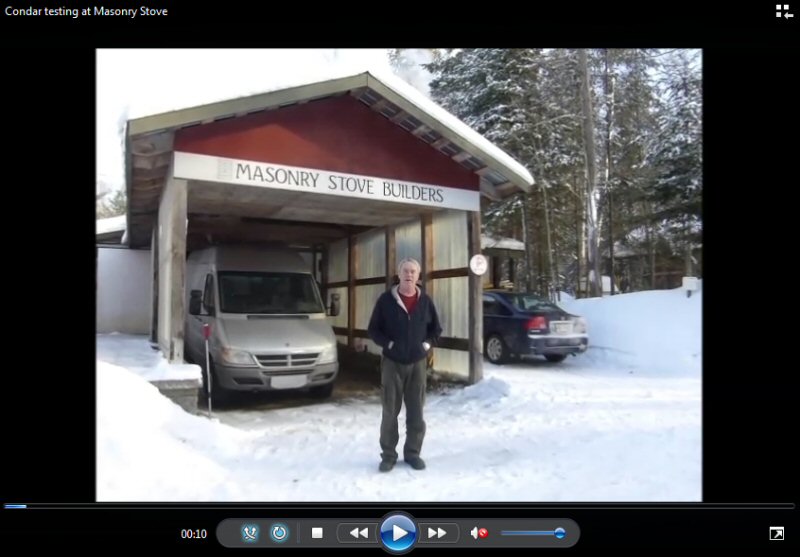
Video of test
February 3/14 - HK-M11
Hard maple 4x4 crib, 55.6 lbs, 21.5% moisure, 7 lbs
kindling
ASTM spec for crib stacking
Stack temperature corrected for height.
Pisla HTT 602 door, 22" wide
Custom air frame, setup "C"
Rear grate reduced 50%,
4th repeat of run HK-M07
1.23 g/kg PM (Condar)
35.22 g/kg CO
72.64% overall efficiency
February 2/14 - HK-M10
Hard maple 4x4 crib, 61.9 lbs, 20.8% moisure, 7 lbs
kindling
ASTM spec for crib stacking
Stack temperature corrected for height.
Pisla HTT 602 door, 22" wide
Custom air frame, setup "C"
Rear grate reduced 50%,
3rd repeat of run HK-M07
1.50 g/kg PM (Condar)
31.86 g/kg CO
73.29% overall efficiency
February 1 /14 - HK-M09
Hard maple 4x4 crib, 59.5 lbs, 19.9% moisure, 7 lbs
kindling
ASTM spec for crib stacking
Stack temperature corrected for height.
Pisla HTT 602 door, 22" wide
Custom air frame, setup "C"
Rear grate reduced 50%,
Second repeat of run HK-M07
1.00 g/kg PM (Condar)
26.66 g/kg CO
73.26% overall efficiency
January 31/14 - HK-M08
Hard maple 4x4 crib, 57.1 lbs, 21.0% moisure, 7 lbs
kindling
ASTM spec for crib stacking
Stack temperature corrected for height.
Pisla HTT 602 door, 22" wide
Custom air frame, setup "C"
Rear grate reduced 50%,
Repeat of run HK-M07
0.72 g/kg PM (Condar)
26.66 g/kg CO
73.62% overall efficiency
January 30/14 - HK-M07
Hard maple 4x4 crib, 61.1 lbs, 19.8% moisure, 7
lbs kindling
ASTM spec for crib stacking
Stack temperature corrected for height.
Pisla HTT 602 door, 22" wide
Custom air frame, setup "C"
Rear grate reduced 50%,
Very clean run because of adequate kindling.
0.73 g/kg PM (Condar)
20.32 g/kg CO
74.57 % overall efficiency
January 29/14 - HK-M06
ASTM crib configuration.
Hard maple 4x4's 57.1 lbs total, incl. 5 lbs kindling. 20.3% moisture.
Efficiency is calculated at 2 hrs burn time
Stack temperature corrected for height.
Add on bell
Pisla HTT 602 door, 22" wide
Custom air frame, setup "C"
1.45 g/kg PM (Condar)
24.70 g/kg CO
74.09 % overall efficiency
January 28/14 - HK-M05
ASTM crib configuration.
Hard maple 4x4's 58.3 lbs total, incl. 3.75 lbs kindling. 21.1%
moisture.
Efficiency is calculated at 2 hrs burn time
Stack temperature corrected for height.
Add on bell
Pisla HTT 602 door, 22" wide
Custom air frame, setup "C"
2.60 g/kg PM (Condar)
28.30 g/kg CO
73.27 % overall efficiency
January 27/14 - HK-M04
ASTM crib configuration.
Hard maple 4x4's 56.6 lbs total, incl. 3.75 lbs kindling. 20.8%
moisture.
Efficiency is calculated at 2 hrs burn time
Stack temperature corrected for height.
Add on bell
Pisla HTT 602 door, 22" wide
Custom air frame, setup "C"
1.28 g/kg PM (Condar)
26.50 g/kg CO
73.49 % overall efficiency
January 26/14 - HK-M03
ASTM crib configuration.
Hard maple 4x4's 57.0 lbs total, incl. 3.75 lbs kindling. 20.3%
moisture.
Efficiency is calculated at 2 hrs burn time
Stack temperature corrected for height.
Add on bell
Pisla HTT 602 door, 22" wide
Custom air frame, setup "B"
2.35 g/kg PM (Condar)
27.52 g/kg CO
71.54 % overall efficiency
January 25/14 - HK-M02
Hard maple 4x4's 57.5 lbs total, incl. 3.75 lbs
kindling. 21.0% moisture.
ASTM crib configuration.
Efficiency is calculated at 2 hrs burn time
Stack temperature corrected for height.
Add on bell
Pisla HTT 602 door, 22" wide
Custom air frame, setup "B"
1.82 g/kg PM (Condar)
32.00 g/kg CO
73.36 % overall efficiency
January 24/14 - HK-M01
Hard maple 4x4's 57 lbs total, incl. 3.75 lbs
kindling. 20.3% moisture.
ASTM crib configuration.
Efficiency is calculated at 2 hrs burn time
Stack temperature corrected for height.
Add on bell
Pisla HTT 602 door, 22" wide
Custom air frame, setup "A"
1.68 g/kg PM (Condar)
30.76 g/kg CO
74.21 % overall efficiency
March 06/10 - HK-L22
White birch, 49.7 lb total, incl. 3.75 lbs kindling.
29.4% moisture.
North-South loading. Largest pieces first. Loaded onto a coal bed
(Colorado method)
Efficiency is calculated at 95% oxygen recovery (Colorado method).
Stack temperature corrected for height.
Add-on bell has been extended in height by 5
courses.
Compared to last run:
Smaller load, cooler firebox.
Lower stack temperature, however lower burn rate results in higher
oxygen, and slightly less overall efficiency
0.71 g/kg PM (Condar)
25.69 g/kg CO
73.95 % overall efficiency
March 05/10 - HK-L21
Third consecutive test with large load of wet birch,
stacked front to back. Not matched to set L19-L20
White birch, 75.8 lb total, incl. 3.75 lbs kindling. 31.1% moisture.
North-South loading. Largest pieces first. Loaded onto a coal bed
(Colorado method)
Efficiency is calculated at 95% oxygen recovery (Colorado method).
Stack temperature corrected for height.
Add-on bell has been extended in height by 5
courses.
Hot firebox resulted in faster burn than set L19-L20
Stack temperature 15 degrees lower than L20
0.85 g/kg PM (Condar)
26.94 g/kg CO
76.03 % overall efficiency
February 26/10 - HK-L20
Second of a pair of matched loads, large loads of wet
birch, stacked front to back.
White birch, 78.1 lb total, incl. 3.75 lbs kindling. 31.7% moisture.
North-South loading. Largest pieces first. Loaded onto a coal bed
(Colorado method)
Efficiency is calculated at 95% oxygen recovery (Colorado method).
Stack temperature corrected for height.
Did not spike like last test, slower controlled start,
yet hotter burn overall, slightly shorter.
Slightly drier, hotter firebox to start, so difference must have been
in the stacking.
40% lower PM, 20% lower CO, 0.6% higher efficiency
1.05 g/kg PM (Condar)
20.28 g/kg CO
74.90 % overall efficiency
February 25/10 - HK-L19
First of a pair of matched loads, large loads of wet
birch, stacked front to back.
White birch, 79.0 lb total, incl. 3.75 lbs kindling. 34.2% moisture.
North-South loading. Largest pieces first. Loaded onto a coal bed
(Colorado method)
Efficiency is calculated at 95% oxygen recovery (Colorado method).
Stack temperature corrected for height.
Modified bell from HK-L17.
1.54 g/kg PM (Condar)
25.92 g/kg CO
74.31 % overall efficiency
February 21/10 - HK-L18
Fuel load similar to HK-L16 and L17. Not matched,
however. Warm heater.
White birch, 51.6 lb total, incl. 3.75 lbs kindling. 31.7% moisture.
North-South loading. Largest pieces first. Loaded onto a coal bed
(Colorado method)
Efficiency is calculated at 95% oxygen recovery (Colorado method).
Stack temperature corrected for height.
Modified bell from HK-L17.
1.30 g/kg PM (Condar)
25.43 g/kg CO
74.38 % overall efficiency
February 20/10 - HK-L17
Second test of a control pair with cordwood.
Matched set of fuel loads. Warm heater.
White birch, 53.1 lb total, incl. 3.75 lbs kindling. 28.3% moisture.
North-South loading. Largest pieces first. Loaded onto a coal bed
(Colorado method)
Efficiency is calculated at 95% oxygen recovery (Colorado method).
Stack temperature corrected for height.
For this test, the bell attached to the heater was
modified. A diverter brick was added
inside. The average stack temperature dropped 13 degrees, and the
efficiency increased
by 1.5%.
0.94 g/kg PM (Condar)
24.97 g/kg CO
74.48 % overall efficiency
February 19/10 - HK-L16
First test of a control pair with cordwood.
Matched set of fuel loads. Warm heater.
White birch, 54.2 lb total, incl. 3.75 lbs kindling. 28.3% moisture.
North-South loading. Largest pieces first. Loaded onto a coal bed
(Colorado method)
Efficiency is calculated at 95% oxygen recovery (Colorado method).
Stack temperature corrected for height.
1.05 g/kg PM (Condar)
26.10 g/kg CO
73.02 % overall efficiency
February 17/10
Data
and statistical summary, 4 matched pairs of crib tests
February 4/10 - HK-L15
Series 4: Test #2 of a 2 test pair with matched cribs.
Warm heater.
Colorado M-4 (MHA Fueling Protocol) cribs. Spruce at 19.4% average
moisture.
Loading factor 0.15 . Reload
3.75 lbs kindling + 26.8 lb crib (19.30 % av moisture) + reload w. 27.4
lb crib (19.52% av moisture).
Efficiency is calculated at 95% oxygen recovery (Colorado method).
Stack temperature corrected for height.
Detailed moisture descriptions of cribs to follow.
Condar spreadsheet contains detailed lab notes.
1.13 g/kg PM (Condar)
24.29 g/kg CO
72.06 % overall efficiency
February 3/10 - HK-L14
Series 4: Test #1 of a 2 test pair with matched
cribs. Warm heater.
Colorado M-4 (MHA Fueling Protocol) cribs. Spruce at 19.1% average
moisture.
Loading factor 0.15 . Reload
3.75 lbs kindling + 27.2 lb crib (19.02 % av moisture) + reload w. 26.8
lb crib (19.11% av moisture).
Efficiency is calculated at 95% oxygen recovery (Colorado method).
Stack temperature corrected for height.
Detailed moisture descriptions of cribs to follow.
Condar spreadsheet contains detailed lab notes.
1.30 g/kg PM (Condar)
23.67 g/kg CO
72.28 % overall efficiency
February 2 /10 - HK-L13
Cold heater. Warmup run for L14/L15, which is the 4th
repeat test with matched cribs, in a warmed heater.
Colorado M-4 (MHA Fueling Protocol) cribs. Spruce at 21.7% average
moisture.
Loading factor 0.15 . Reload
3.75 lbs kindling + 27.0 lb crib (21.57 % av moisture) + reload w. 26.7
lb crib (21.85% av moisture).
Efficiency is calculated at 95% oxygen recovery (Colorado method).
Stack temperature corrected for height.
Lower PM than L12, which was 5% lower moisture (16.7%), also smaller
load, and cool heater instead of cold heater.
First test with a new batch of 2x4 lumber, from a different supplier
than L05 - L12
1.55 g/kg PM (Condar)
31.04 g/kg CO
71.53 % overall efficiency
January 26/10 - HK-L12
Series 3: Test #2 of a 2 test pair with matched cribs.
Cool heater. Fired 24 hours previously, but ashbox door and chimney
damper left open by mistake.
Colorado M-4 (MHA Fueling Protocol) cribs spruce at 16.7% average
moisture.
Loading factor 0.13 . Reload
3.75 lbs kindling + 18.8 lb crib (16.72 % av moisture, estimated) +
reload w. 16.2 lb crib (16.72% av measured moisture).
Efficiency is calculated at 95% oxygen recovery (Colorado method).
Stack temperature corrected for height.
This test seems very close to the previous one. The colder start could
account for the higher PM.
1.98 g/kg PM (Condar)
22.55 g/kg CO
73.13 % overall efficiency
Compared to HK-L11:
This test seems very close.
The colder start could account for the higher PM, and the slightly
higher efficiency.
Average stack temperature was 8 degrees (F) lower.
January 25/10 - HK-L11
Series
3: Test #1 of a 2 test pair with matched cribs. Warm heater. See fuel
notes Colorado M-4 (MHA Fueling Protocol) cribs spruce at 16.1% average
moisture.
Loading factor 0.13 . Reload
3.75 lbs kindling + 18.8 lb crib (16.10 % av moisture) + reload w. 16.8
lb crib (16.10% av moisture).
Efficiency is calculated at 95% oxygen recovery (Colorado method).
Stack temperature corrected for height.
1.71 g/kg PM (Condar)
22.48 g/kg CO
73.00 % overall efficiency
January 24/10 - HK-L10
Series 2: Test #2 of a 2 test pair with matched cribs.
Warm heater.
Colorado M-4 (MHA Fueling Protocol) cribs spruce at 16.1% average
moisture.
Loading factor 0.15 . Reload
3.75 lbs kindling + 26.6 lb crib (16.56 % av moisture) + reload w. 24.6
lb crib (15.60% av moisture).
Efficiency is calculated at 95% oxygen recovery (Colorado method).
Stack temperature corrected for height.
2.28 g/kg PM (Condar)
23.22 g/kg CO
72.92 % overall efficiency
Compared to HK-L09:
- load was 6% (3.2 lbs) heavier
- kindling slightly slower, more left to ignite crib
- first crib burned slightly faster
- an error was made on the second crib, and it was loaded upside down.
This meant that it had spacers underneath, whereas normally the crib
has been loaded directly onto the coal. This allowed more air under,
resulting in a faster start, and a higher CO spike than L-08.
The
batch of 2x4's used for the last 4 tests has been very variable in
moisture, both piece to piece, adjacent pieces cut out of the same
stick, and particularly from the surface to the core. A more detailed
description of the matching technique used will follow. A third
back-to-back test from the same batched is planned for tomorrow (Jan
25) and Jan 26. Obtaining more uniform fuel will be the next task.
January 23/10 - HK-L09
Series 2: Test #1 of a 2 test pair with matched cribs
at 16.1% moisture.Warm heater.
Colorado M-4 (MHA Fueling Protocol) cribs.
Loading factor 0.15 . Reload
3.75 lbs kindling + 25.8 lb crib (16.28% moisture) + reload w. 25.8 lb
crib (15.82% moisture).
Efficiency is calculated at 95% oxygen recovery (Colorado method).
Stack temperature corrected for height.
1.79 g/kg PM (Condar)
22.52 g/kg CO
73.27 % overall efficiency
January 22/10 - HK-L08
Series 1: Test #2 of a 2 test pair with matched
cribs. Warm heater.
Colorado M-4 (MHA Fueling Protocol) cribs (spruce at 20.2% average
moisture).
Loading factor 0.15. Reload
3.75 lbs kindling + 24.0 lb crib (20.23% moisture) + reload w. 24.0 lb
crib (20.25% moisture).
Efficiency is calculated at 95% oxygen recovery (Colorado method).
Stack temperature corrected for height.
1.63 g/kg PM (Condar)
26.14 g/kg CO
71.83 % overall efficiency
January 21/10 - HK-L07
Series 1: Test #1 of a 2 test pair with matched cribs.
Warm heater.
Colorado M-4 (MHA Fueling Protocol) cribs (spruce at 19.7% average
moisture.) Loading factor 0.15. Reload
3.75 lbs kindling + 24.0 lb crib + reload w. 25.0 lb crib.
Efficiency is calculated at 95% oxygen recovery (Colorado method).
Stack temperature corrected for height.
1.55 g/kg PM (Condar)
26.85 g/kg CO
71.47 % overall efficiency
January 20/10 - HK-L06
Cold heater. Colorado M-4 (MHA Fueling Protocol) fuel
cribs.
Loading factor 0.13. Reload
3.75 lbs kindling + 22 lb crib + reload w. 22.6 lb crib.
Efficiency is calculated at 95% oxygen recovery (Colorado method).
Stack temperature corrected for height.
1.83 g/kg PM (Condar)
21.8 g/kg CO
74.6 % overall efficiency
January 12/10 - HK-L05
Warm heater. Fuel crib of very dry spruce. Larger crib
than L03/L04
3.75 lbs kindling. 51.6 lbs total instead of 39 lbs.
Efficiency is calculated at 95% oxygen recovery (Colorado method).
Stack temperature corrected for probe height.
2.94 g/kg PM (Condar)
93.43 g/kg CO
70.0 % overall efficiency
January 11/10 - HK-L04
Warm heater. Crib of very dry spruce. Same crib as
L03, except spacers changed for more air.
3.75 lbs kindling. 38.5 lbs total. Regular kindling insead of a crib.
Efficiency is calculated at 95% oxygen recovery (Colorado method).
Stack temperature corrected for probe height.
1.45 g/kg PM (Condar)
34.55 g/kg CO
70.5% overall efficiency
January 10/10 - HK-L03
Cold heater. small crib of dry spruce. Spacers not
correct - blocking some airflow through pile.
3.75 lbs kindling. 39.8 lbs total.
Efficiency is calculated at 95% oxygen recovery (Colorado method).
2.17 g/kg PM (Condar)
38.71 g/kg CO
69.4% overall efficiency
January 6/10 - HK-L02
Warm heater. Large crib of 10% moisture spruce,
followed by a load of 25% moisture hardwood
122.5 lbs total
Gas reading were lost due to computer crash
- estimated values used to obtain a rough PM number
1.9 g/kg PM (Condar)
January 5/10 - HK-L01
Cold heater. Cold fuel. No draft,
slow start, dirty burn.
9 pieces dry hardwood. 4.5 lbs kindling. 59 lbs total.
Efficiency now is calculated at 95% oxygen recovery (Colorado method)
Highest PM on record.
4.61 g/kg PM (Condar)
48.9 g/kg CO
69.1% overall efficiency
February 25/09 - HK-K37
Warm heater. Previous fire 24 hrs.
White Birch, 20% moisture
Llarge load. Two very large pieces at bottom. 3 small pieces on top
9 pieces. 4.5 lbs kindling. 68.4 lbs total. Pieces smaller than
yesterday: 7.1 lbs vs. 8.9 lbs
Clean start. No overamping, except for second poke. Pieces stacked too
tight.
Kindling ran out of steam, added 1.5 lbs.
Low CO. Very low PM. Compared with run HK-K36,
CO is higher, PM is lower.
Air control closed at 115 minutes. Data for calculation based on 114
minutes. Flue damper left open 1",
closed 6 hrs later.
.65 g/kg PM (Condar)
21.30 g/kg CO
69.4% overall efficiency
February 24/09 - HK-K36
Warm heater. Previous fire 24 hrs.
White Birch, 20% moisture
Very large load. Two very large pieces (12.8 lbs ea) at bottom. 3 small
pieces on top
10 pieces. 3.3 lbs kindling. 81.9 lbs total. Pieces larger than
yesterday: 8.9 lbs vs. 5.9 lbs
Very staged burn. Clean start. No overamping.
Low CO. Low PM. Compared with run HK-K35,
CO is lower, PM is higher.
Air control closed at 120 minutes. Data for calculation based on 120
minutes. Flue damper left open 1", closed 6 hrs later.
.90 g/kg PM (Condar)
14.33 g/kg CO
70.13% overall efficiency
February 23/09 - HK-K35
Very warm heater. Previous fire 15 hrs.
White Birch, 20% moisture
Big load. Two very large pieces (12.3 lbs ea) at bottom. 3 small pieces
on top
11 pieces. 3.5 lbs kindling. 68.3 lbs total. Pieces larger than
yesterday: 5.9 lbs vs. 4.6 lbs
Very staged burn. Clean start. Slight, prolonged overamping at 23
minutes
Moderate CO. Low PM. Compare with run HK-K34
Air control closed at 94 minutes. Data for calculation based on 100
minutes. Flue damper left open 1".
.70 g/kg PM (Condar)
22.82 g/kg CO
69.2% overall efficiency
February 22/09 - HK-K34
Hot heater. Previous fire 7 hrs.
White Birch, 20% moisture
Small pieces, big load, stacked front to back. Ignition from top.
15 pieces. 3.3 lbs kindling. 73.0 lbs total. Pieces larger than
yesterday: 4.6 lbs vs. 3.2 lbs
Very staged burn. Clean start. Moderate overamping at 25 minutes
Moderate CO. Low PM. Compare with run HK-K33
.80 g/kg PM (Condar)
25.68 g/kg CO
70.5% overall efficiency
February 22/09 - HK-K33
Warm heater. Previous fire 13 hrs.
White Birch, 20% moisture
"Austrian style fuel". Very small pieces. 18 pieces. 3.9 lbs kindling.
60.4 lbs total. Pieces larger than yesterday: 3.2 lb vs. 2.1 lbs
Stacked front to back. Ignition from top
Very staged burn. Clean start. Overamping starting at 35 minutes.
Moderate CO. Low PM. Compare with run HK-K32
Data for calculation stopped at 70 minutes, when air control was
closed.
Flue damper left open 0.5".
.94 g/kg PM (Condar)
27.97 g/kg CO
73.3% overall efficiency
February 21/09 - HK-K32
Warm heater. Previous fire 8 hrs. Hot firebox.
White Birch, 20% moisture
"Austrian style fuel".
Very small pieces. 17 pieces. 3.5 lbs kindling. 39.7 lbs total, stacked
teepee style.
Very fast, clean start. CO peak at 12 minutes.
Fast burn - 50 minutes
Moderate CO. Low PM. Compare with run HK-K31
Data for calculation stopped at 50 minutes, when air control was
closed.
Flue damper left open 0.5".
.84 g/kg PM (Condar)
22.04 g/kg CO
71.9% overall efficiency
February 21/09 - HK-K31
Warm heater. Previous fire 24 hrs.
Firebox door left open overnight - firebox not very hot.
White Birch, 20% moisture
"Austrian style fuel".
Very small pieces. 10 pieces. 4 lbs kindling. 35.5 lbs total, stacked
teepee style.
False start, more kindling added at 6 minutes
Slow burn, low opacity, high oxygen, steady CO
Moderate CO. Moderate PM. Low stack temp, high oxygen, lower efficiency.
Data for calculation stopped at 80 minutes, when air control was
closed.
Flue damper left open 1" and shut 4 hrs later.
1.18 g/kg PM (Condar)
27.61 g/kg CO
69.4% overall efficiency
February 20/09 - HK-K30
Warm heater. Previous fire 24 hrs.
White Birch, 20% moisture
4 large pieces, 3 medium pieces, 3 small pieces. 4.5 lbs kindling, 76.2
lbs total
Pieces loaded in hot heater, 8 hrs after fire, and baked in firebox for
14 hours.
Standard log cabin stacking. Side kindling, newspaper near top.
Kindling not baked.
3 small pieces on top, next to the kindling.
Good bright ignition. Huge CO spike at 14 minutes. CO never really
cleaned up
High CO. Moderate PM.
Data for calculation stopped at 90 minutes, when air control was
closed.
Cold air bypass open. Doors not taped. Flue damper left open 1" and
shut 4 hrs later.
1.35 g/kg PM (Condar)
39.53 g/kg CO
71.3% overall efficiency
February 19/09 - HK-K29
Warm heater. Previous fire 24 hrs.
White Birch, 20% moisture
5 large pieces, 3 small pieces. 4.5 lbs kindling, 67.2 lbs total
Standard log cabin stacking. Side kindling, staged.
3 small pieces on top, next to the kindling.
Good clean ignition. Moderate CO spike at 25 minutes
Moderate CO. Low PM.
Data for calculation stopped at 90 minutes, when air control was
closed.
Cold air bypass open. Doors not taped. Flue damper left open 1" and
shut 4 hrs later.
0.77 g/kg PM (Condar)
19.81 g/kg CO
72.5 % overall efficiency
February 18/09 - HK-K28
Warm heater. Previous fire 24 hrs.
White Birch, 20% moisture
6 large pieces. 1 small piece. 4.5 lbs kindling, 63.4 lbs total
Standard log cabin stacking. Side kindling, staged.
Wood was cold. The single small piece was put at the front of the
second row.
Slow ignition due to cold wood, then overamping due to the small piece,
then underamping (rebound from the overamping). See gas curves.
High CO. Relatively high PM.
Data for calculation stopped at 90 minutes, when air control was
closed.
Cold air bypass open. Doors not taped. Flue damper left open 1" and
shut 4 hrs later.
1.93 g/kg PM (Condar)
40.22 g/kg CO
71.3 % overall efficiency
February 17/09 - HK-K27
Warm heater. Previous fire 24 hrs.
White Birch, 20% moisture
Small pieces. 9 pieces, 4.5 lbs kindling, 60.6 lbs total
Standard log cabin stacking. Top kindling. See stacking photo.
Well staged ignition, avoiding CO spike at start.
Data for calculation stopped at 90 minutes, when air control was
closed.
Cold air bypass open. Doors not taped. Flue damper left open 1" and
shut 4 hrs later.
0.82 g/kg PM (Condar)
12.47 g/kg CO
73.6 % overall efficiency
February 16/09 - HK-K26
Warm heater. Previous fire 24 hrs.
White Birch, 20% moisture
Large pieces. 8 pieces, 4.5 lbs kindling, 69.4 lbs total
Standard log cabin stacking. Side kindling, staged from top.
Data for calculation stopped at 100 minutes, when air control was
closed.
Cold air bypass open. Doors not taped. Flue damper left open 1" and
shut 6 hrs later.
0.74 g/kg PM (Condar)
20.93 g/kg CO
70.7 % overall efficiency
February 15/09 - HK-K25
Warm heater. Previous fire 24 hrs.
White Birch, 20% moisture
Large pieces. 7 pieces, 4.5 lbs kindling, 64.1 lbs total
Pieces stacked front to back. Kindling as shown
Bad stacking, bad kindling location. Pile didn't catch, newspaper was
added at 23 minutes
Pile poked twice. Slow burn, elevated oxygen, continuous low level CO..
Data for calculation stopped at 120 minutes, when air control was
closed.
Cold air bypass open. Doors not taped. Flue damper shut 2 hrs after air
was shut.
1.05 g/kg PM (Condar)
27.20 g/kg CO
69.9 % overall efficiency
February 14/09 - HK-K24
Slightly warm heater. Large load 48 hrs previous,
damper closed
White Birch, 20% moisture
Very large pieces. 8 pieces, 4.5 lbs kindling, 73.5 lbs total
Pieces stacked front to back. Kindling on right side, lit from top
Very fast and clean start. 2pc left-to-right on rear grate, to provide
delayed ignition from
the grate location. This was a mistake - load overamped, very high CO
starting at about 10 minutes
Low PM, high CO. Efficiency loss from CO alone was 4.6%
Data for calculation stopped at 90 minutes, when air control was
closed.
Cold air bypass open. Doors not taped. Flue damper shut 2 hrs after air
was shut.
0.97 g/kg PM (Condar)
40.78 g/kg CO
72.6 % overall efficiency
February 12/09 - HK-K23
Very warm heater - large load yesterday, with damper
closed, weather warmer than during most of the testing.
White Birch, 20% moisture
Very small pieces. 16 pieces, 4.5 lbs kindling, 61.4 lbs total
Pieces stacked front to back. Kindling on top.
Sluggish start. Chimney was cold, 59F. Slight spillage on start. Water
condensed on the glass, big CO spike.
Data for calculation stopped at 90 minutes, when air control was
closed.
Cold air bypass open. Doors not taped. Flue damper shut 2 hrs after air
was shut.
1.12 g/kg PM (Condar)
26.79 g/kg CO
74.4 % overall efficiency
February 11/09 - HK-K22
Warm heater - damper had been left open, ashbox air
control closed. Seal on door. Cold air bypass open.
White Birch, 20% moisture
Large load, very large pieces, 8 pieces, 4.5 lbs kindling, 76.8 lbs
total
Pieces stacked front to back. Kindling stacked between two pieces on
right(see stacking pattern)
Sluggish start due to kindling configuration - newspaper wadded into
too tight a space.
Data for calculation stopped at 112 minutes, when air control was
closed.
Cold air bypass open. Doors not taped. Flue damper shut 2 hrs after air
was shut.
0.88 g/kg PM (Condar)
13.45 g/kg CO
75.4 % overall efficiency
February 10/09 - HK-K21
Slightly warm heater - damper had been left open,
ashbox air control closed. Cold air bypass was open.
White Birch, 20% moisture
Small, 11 pieces, 4.5 lbs kindling, 62.6 lbs total
Pieces stacked front to back. Kindling stacked between two pieces on
right(see stacking pattern)
Zero CO spike at the beginning. Extremely clean start. Overamped at 19
minutes.
Low oxygen value (good efficiency)
Data for calculation stopped at 81 minutes, when air control was
closed.
Flue damper left open. Cold air bypass open.
Same as yesterday, except door and ashbox door taped shut (reduced
leakage).
1.11 g/kg PM (Condar)
23.52 g/kg CO
74.3 % overall efficiency
February 9/09 - HK-K20
Slightly warm heater - damper had been left open,
ashbox air control closed.
No seal on doors.
White Birch, 20% moisture
Large, 7 pieces, 4.5 lbs kindling, 62.8 lbs total
Pieces stacked front to back.
Kindling stacked between two pieces on right (see stacking pattern)
Zero CO spike at the beginning. Very low CO overall.
Very low PM.
Very steady oxygen value.
Data for calculation stopped at 90 minutes, when air control was
closed.
Flue damper left open. Cold air bypass open.
0.67 g/kg PM (Condar)
10.57 g/kg CO
72.8 % overall efficiency
February 8/09 - HK-K19
Slightly warm heater - damper had been left open,
ashbox air control closed. No seal on doors.
White Birch, 20% moisture
Small wood, 11 pieces, 4.5 lbs kindling, 64.2 lbs total
Pieces stacked front to back. Kindling on top, favoring right side (see
stackin pattern)
No CO spike at the beginning. Very steady oxygen value.
Data for calculation stopped at 71 minutes, when air control was
closed.
Flue damper left open. Cold air bypass closed.
0.89 g/kg PM (Condar)
13.03 g/kg CO
74.6 % overall efficiency
February 7/09 - HK-K18
Slightly warm heater - damper had been left open,
ashbox air control 1/2 open.
White Birch, 20% moisture
9pieces, 4.5 lbs kindling, 61.6 lbs total
Pieces tacked front to back. Kindling on top, favoring right side (see
stackin pattern)
No CO spike at the beginning. Very steady oxygen value.
Data for calculation stopped at 71 minutes, when air control was
closed.
Flue damper left open. Cold air bypass open. See surface
temp curves
0.54 g/kg PM (Condar)
13.7 g/kg CO
72.0 % overall efficiency
Will repeat with small wood, to
get more reliable numbers for HK-K17
February 6/09 - HK-K17
Cool heater - damper and ashbox door had been left
open from yesterday's burn
White Birch, 20% moisture
12 pieces, 4.5 lbs kindling, 64.4 lbs total
Smaller pieces, stacked front to back. Kindling on top.
No CO spike at the beginning, a very significant result.
Data problems with Testo analyzer, see notes below gas graph.
Ashbox door closed, air inlet left open 50% to
simulate a slightly leaky heater. Damper left open.
Cold air bypass closed.
0.93 g/kg PM (Condar)
13.9 g/kg CO
76.7 % overall efficiency
Very good numbers, but not
reliable due to data loss. See notes with gas graph.
February 5/09 - HK-K16
Warm heater
White Birch, 20% moisture
9 pieces, 4.5 lbs kindling, 63.6 lbs total
Smaller pieces, kindling stacked tighter than HK-K15, to slow down start
Slower start. CO and PM spikes, delayed and smaller than HK-K15.
Air left open, flue damper left open. Data collection
stopped at 120 minutes.
Very low efficiency at the end, which reduced overall average to 70.0%,
slightly lower than others
This is a reference run to get surface temperature data for a cycle
with damper open plus ashbox door open (worst case).
1.12 g/kg PM (Condar)
24.99 g/kg CO
70.0 % overall efficiency
February 4/09 - HK-K15
Warm heater
White Birch, 20% moisture
8 pieces, 4.5 lbs kindling, 60.6 lbs total
Smaller pieces, very fast start in kindling stack.
CO spike at beginning, PM spike.
Air closed at 72 minutes with glowing coal bed.
Flue damper left open.
2.09 g/kg PM (Condar)
18.28 g/kg CO
73.1 % overall efficiency
February 3/09 - HK-K14
Warm heater
White Birch, 20% moisture
6 pieces, 4.5 lbs kindling, 62.3 lbs total
Two large logs on bottom.
Air closed at 100 minutes with glowing coal bed.
Flue damper left open.
1.02 g/kg PM (Condar)
15.86 g/kg CO
71.3 % overall efficiency
February 2/09 - HK-K13
Cold heater
White Birch, 20% moisture
6 pieces, 4.5 lbs kindling, 63.0 lbs total
1.02 g/kg PM (Condar)
15.86 g/kg CO
70.7% overall efficiency
January 19/09 - HK-K12
Warm heater
Air closed at 115 minutes. Damper cut back. Closed at 275 minutes.
Somewhat tight stacking, resulting in a bit of PM.
Large kindling, slower start.
White Birch, 20% moisture
7 pieces, 4.5 lbs kindling, 63.0 lbs total
0.89 g/kg PM (Condar)
11.70 g/kg CO
71.7 % overall efficiency
Damper
data summary
January 18/09 - HK-K11
Warm heater.
Air closed at 112 minutes. Damper left open.
Very staged burn, with evenly shaped half logs.
No overamping, very low CO
White birch, 20% moisture
7 pieces, 4.8 lb kindling, 63.5 lbs total
0.83 g/kg PM (Condar)
7.65 g/kg CO
72.5 % overall efficiency
January 17/09 - HK-K10
Warm heater. Surface temperatures
are being tracked for damper comparisons, and data will be added later
Damper closed at end of run.
White birch, 20% moisture
7 pieces, 4.3 lb kindling, 60.3 lbs total
Oxygen calibration error. Oxygen
values were adjusted in the Condar spreasheet. See Testo spreadsheet
for
details.
0.79 g/kg PM (Condar)
9.37 g/kg CO
75.7 % overall efficiency
January 16/09 - HK-K09
Warm heater. Surface temperatures
are being tracked for damper comparisons, and data will be added later
Damper left open at end of run
White birch, 20% moisture
8 pieces, 4.3 lb kindling, 63.1 lbs total
Very nice clean, staged start.
Fast start.
Slightly smaller wood (8 pieces)
1.00 g/kg PM (Condar)
26.99 g/kg CO
72.3 % overall efficiency
January 15/09 - HK-K08
Warm heater. Surface temperatures
are being tracked for damper comparisons, and data will be added later
Damper closed at end of run. (Jan 17/09: damper was found not to be
closing all the way. See heatkit.com/research/2009/lopezk-labjack.htm)
White birch, 20% moisture
7 pieces, 4.3 lb kindling, 62.1 lbs total
Very nice clean, staged start.
Pieces stacked a little looser than HK-K07 (yesterday)
0.53 g/kg PM (Condar)
12.42 g/kg CO
70.1 % overall efficiency
January 14/09 - HK-K07
Warm heater. Surface temperatures
are being tracked for damper comparisons, and data will be added later
Damper left open at end of run.
White birch, 20% moisture
6 pieces, 4.5 lb kindling, 60.5 lbs total
pieces stacked close together. 2
bottom pieces did not allow air circulation,
slowed down the burn, resulting in slightly higher oxygen and lower
efficiency
0.81 g/kg PM (Condar)
15.50 g/kg CO
69.2 % overall efficiency
January 13/09 - HK-K06
Warm heater. Surface temperatures
are being tracked for damper comparisons, and data will be added later
Damper closed at end of run. (Jan 17/09: damper was found not to be
closing all the way. See heatkit.com/research/2009/lopezk-labjack.htm)
White birch, 20% moisture
6 pieces, 4.5 lb kindling, 63.2 lbs total
False start, had to light kindling
newspaper at middle of pile.
First test with grate air open.
Noticeably better burn. Low CO, low PM
0.59 g/kg PM (Condar)
11.43 g/kg CO
72.1 % overall efficiency
NOTE: Condar
spreadsheet calculation was modified, starting with this run.
The old spreadsheet was set up for gas readings at 5 minute intervals,
which were entered
from the TESTO data spreadsheet.
Now, the averages are calculated directly off the TESTO data, at 30
second intervals, instead of 5 minutes.
January 12/09 - HK-K05
Warm heater. Surface temperatures
are being tracked for damper comparisons, and data will be added later
Damper left open, with cold air bypass open.
White birch, 20% moisture
6 pieces, 4.5 lb kindling, 63.4 lbs total
Large CO and PM spike about 15
minutes in.
5% efficiency loss due solely to CO, about 3% higher than normal.
Grate air inadvertently closed for entire run.
2.29 g/kg PM (Condar)
45.5 g/kg CO
71.9 % overall efficiency
January 11/09 - HK-K04
Warm heater. Surface temperatures
are being tracked for damper comparisons, and data will be added later.
Damper closed at end of run. (Jan 17/09: damper was found not to be
closing all the way. See heatkit.com/research/2009/lopezk-labjack.htm)
White birch, 20% moisture
6 pieces, 4.5 lb kindling, 63.7 lbs total
Equipment malfunction from minute
0 to 35. Gas values during that interval estimated from previous test.
Kindling mis-start, see details
below. Higher PM than previous tests, at 1.5 g/kg.
Grate air inadvertently closed for entire run.
1.47 g/kg PM (Condar)
17.0 g/kg CO
71.7 % overall efficiency
January 10/09 - HK-K03
Warm heater. Surface temperatures
are being tracked for damper comparisons, and data will be added later
White birch, 20% moisture
6 pieces, 4.5 lb kindling, 62.3 lbs total
0.48 g/kg PM (Condar)
16.2 g/kg CO
71.7 % overall efficiency
Grate air inadvertently closed for
entire run
January 9/09 - HK-K02
Warm heater. Surface temperatures
are being tracked for damper comparisons, and data will be added later
White birch, 20% moisture
7 pieces, 4.5 lb kindling, 63.7 lbs total
0.60 g/kg PM (Condar)
13.5 g/kg CO
75.3% overall efficiency
Slightly lower PM due to warm
heater. Very consistent CO and efficiency with yesterday
Grate air inadvertently closed for entire run
January 8/09 - HK-K01
This is the first run in the HK-K
series. Cold heater, warmup run.
Aim is to run a set of consistent
repeat runs, to energize the heater identically, for a series of
chimney damper tests
White birch, 20% moisture
6 pieces, 4.5 lb kindling, 65.1 lbs total
Difficulty lighting the kindling
from the top, with a cold heater.
Fuel pieces were a bit large, 10.1 lbs average
0.94 g/kg PM (Condar)
13.3 g/kg CO
75.2% overall efficiency
Grate air inadvertently closed for entire run
Graphical
Data Summary
Correlation
Between Condar PM number and Opacity Curve
Data
Analysis
February 23/08 - HK-J30
This is the last run in the HK-J
series.
Largest fuel load of 30 run series.
Maple, 18% moisture, 78.0 lbs
5 round pieces of maple, with 3 pieces of white birch on top, 2 on
bottom, 10pieces
Warm heater (162F firebox temp), cold fuel
Side ignition
Cold kindling, 4.0 lbs
Similar to run HK-J29, 1/2 lb more
kindling, larger load.
Nice clean start, then fire overamped at 27 minutes, creating large
opacity spike for 10 minutes.
Dark grey smoke from stack. However, PM number still reasonably low,
indicating that this was pure soot with no tar, as would be expected at
this stage in the burn.
This is an interesting demonstration of the high opacity, low mass
nature of the soot component of PM.
1.0 g/kg PM (Condar)
21.5 g/kg CO
74.2% overall efficiency
February 22/08 - HK-J29
Lowest surface/volume (largest
pieces) of 30 run series
Mixed hardwood, 18% moisture,
70.3 lbs
Round pieces, 2 small pieces of white birch on top, 9 pieces
Stack sloped slightly towards kindling
Warm heater (132F firebox temp), cold fuel
Side ignition
Cold kindling, 3.5 lbs (not enough)
Almost identical load to run HK-J26 (very clean), except a
borderline start, requiring one additional piece of kindling.
Interesting example of non-linear system -- high sensitivity to initial
conditions.
1.1 g/kg PM (Condar)
19.3 g/kg CO
70.1% overall efficiency
February 21/08 - HK-J28
Highest CO of 30 run series
Maple, 16% moisture, 50.3 lbs
Small pieces, smaller on top, 11 pieces
Stack sloped towards kindling
Warm heater (144F firebox temp), cold fuel
Side ignition
Cold kindling, 4.0 lbs (too much)
Highest PM and CO of any of the
"Maple, warm firebox, side ignition" runs.
Also highest surface to volume ratio (smallest pieces), very dry.
1.7 g/kg PM (Condar)
43.7 g/kg CO
71.3% overall efficiency
February 20/08 - HK-J27
Lowest instantaneous CO/CO2 ratio
of 30 run series
White birch, 20% moisture, 70.0 lbs
Medium pieces, smaller on top, 10 pieces
Stack sloped towards kindling
Cold heater (90 F firebox temp), Cold fuel (-5 F)
Side ignition.
Cold kindling, 3.5 lbs with 2.25 lbs extra added at 18 minutes (see gas
curves)
Lowest instantaneous CO/CO2 ratio of 30 run series - 0.0002 at 84.5
minutes (10 ppm)
1.4 g/kg PM (Condar)
16.7 g/kg CO
72.3% overall efficiency
February 18/08 - HK-J26
Maple, 17% moisture, 68.5 lbs
Medium pieces, all round pieces, smaller on top, 10 pieces
Stack sloped towards kindling
Warm heater (180F firebox temp), warm fuel
Side ignition.
Cold kindling, 3.5 lbs.
0.6 g/kg PM (Condar)
14.7 g/kg CO
74.5% overall efficiency
February 17/08 - HK-J25
Maple, 17% moisture, 69.6 lbs
Large pieces, smaller on top, 8 pieces
Stack sloped towards kindling
Warm heater (167F firebox temp), warm fuel (40F)
Side ignition.
Cold kindling, 3.5 lbs. -- 4 lbs would have been better.
0.9 g/kg PM (Condar)
35.9 g/kg CO
73.3% overall efficiency
February 16/08 - HK-J24
White birch, 20% moisture, 61.3
lbs
Large pieces, smaller on top, 8 pieces
Stack sloped towards kindling
Warm heater (145F firebox temp), cold fuel (0F)
Side ignition.
Cold kindling, small kindling, large amount, very rapid start.
0.9 g/kg PM (Condar)
21.2 g/kg CO
72.7% overall efficiency
February 15/08 - HK-J23
Lowest CO of 30 run series
White birch, 20% moisture, 70.5 lbs
Very large pieces, smaller on top, 7 pieces
Stack sloped towards kindling
Warm heater (137F firebox temp), warm fuel
Side ignition.
Cold kindling, false start, needed boost with torch
Last 10 minutes of gas data lost - substituted with estimated data.
Very low CO.
0.8 g/kg PM (Condar)
13.7 g/kg CO
73.0% overall efficiency
February 14/08 - HK-J22
White birch, 20% moisture, 59.3
lbs
Large and small pieces, 10 pieces, 3.0 lbs kindling
Warm heater (160F firebox temp), warm fuel.
Start was too fast with the birch bark catching right away.
Side ignition.
1.6 g/kg PM (Condar)
36.3 g/kg CO
73.0% overall efficiency
February 13/08 - HK-J21
White birch, 20% moisture, 65 lbs
Large pieces, 8 pieces, 3.5 lbs kindling
Cold heater (80F firebox temp), cold fuel (10F)
Side ignition.
1.0 g/kg PM (Condar)
19.4 g/kg CO
76.8% overall efficiency
February 11/08 - HK-J20
Maple, 17% moisture, 58 lbs
Large pieces, 8 pieces, 4.2 lbs kindling
Cold heater (50F firebox temp), cold fuel (0F)
Compare with HK-J19 (below) -- this is one
scenario where the faster start from bottom
may have an advantage.
Side ignition
2.3 g/kg PM (Condar)
27.6 g/kg CO
74.1% overall efficiency
February 6/08 - HK-J19
Maple, 17% moisture, 55 lbs
Large and small mixed, 8 pieces, 1.5 lbs kindling
Cold heater (48 hrs, 100F firebox temp), cold fuel
Bottom ignition.
1.1 g/kg PM (Condar)
27.9 g/kg CO
74.6% overall efficiency
February 4/08 - HK-J18
White birch, 19% moisture, 55 lbs
13 pieces, 1.5 lbs kindling
Warm heater, warm fuel, small fuel. Bottom ignition, regular air slot
Kindling went out, restarted with torch.
3.3 g/kg PM (Condar)
39.7 g/kg CO
73.8% overall efficiency
February 3/08 - HK-J17
Mixed hardwood, 21% moisture, 64
lbs
8 pieces, 3.2 lbs kindling
Warm heater, warm fuel
0.9 g/kg PM (Condar)
26.8 g/kg CO
73.8 % overall efficiency
February 2/08 - HK-J16
Highest moisture of 30 run series
Highest kindling weight of 30 run series
Wet hardwood, maple and oak, 35%
moisture, 84 lbs
12 pieces, 12 lbs kindling
Cold heater (66F), side kindling
Difficult to start. Had to add more kindling twice.
1.9 g/kg PM (Condar)
41.4 g/kg CO
71.9 % overall efficiency
January 30/08 - HK-J15
Large and small maple, 16%
moisture,
53 lbs, 9 pieces, 3.3 lbs kindling
Warm heater, cold fuel, side kindling
Clean run. Piece #1 on bottom was too large, difficult
to manage coals at end.
0.7 g/kg PM (Condar)
24.3 g/kg CO
74.8 % overall efficiency
January 29/08 - HK-J14
Large and medium maple, 16%
moisture,
65 lbs, 8 pieces, 5.5 lbs kindling
Warm heater, cold fuel, side kindling
Mis-start, extra newspaper added.
Also, fuel pile was slow to catch and required 1.5 lbs added kindling.
1.5 g/kg PM (Condar)
23.8 g/kg CO
74.4 % overall efficiency
January 28/08 - HK-J13
OMNI ASTM fuel crib, 10% moisture
44.6 lbs
12 pieces, 2 lbs kindling
Room temp fuel. Warm heater (24 hrs)
Kindling from the side.
Regular air slot in front - 1"
1.0 g/kg PM (Condar)
19.9 g/kg CO
75.1 % overall efficiency
Compare with crib tests
HK-J12, HK-H13, and HK-H12
January 27/08 - HK-J12
Highest PM number of 30 run series
Highes Surface/Volume of 30 run series
Lowest moisture of 30 run series
OMNI ASTM fuel crib, 10% moisture
47.2 lbs
12 pieces, 6 lbs kindling
Room temp fuel. Warm heater (24 hrs)
Kindling from the bottom (underneath pile)
Modified air - front slot reduced 50%
3.6 g/kg PM (Condar)
36.5 g/kg CO
74.7 % overall efficiency
Compare with crib tests
HK-H13,
and HK-H12
January 26/08 - HK-J11
White birch, small pieces, 19%
moisture, medium load 41 lbs
12 pieces, 1.8 lbs kindling
Cold fuel. Cold heater (66F)
Kindling from the bottom (underneath pile)
Modified air - front slot reduced 50%
1.0 g/kg PM (Condar)
22.1 g/kg CO
78.3 % overall efficiency
January 23/08 - HK-J10
Maple, large pieces, 16% moisture,
large load 70 lb.
6 pieces, 2.5 lbs kindling
Cold fuel (0F). Cold heater (66F)
Kindling from the bottom (underneath pile)
1.5 g/kg PM (Condar)
38.6 g/kg CO
74.3 % overall efficiency
January 21/08 - HK-J09
White birch, large and small
pieces, 20% moisture, medium load 48.7 lbs
9 pieces, 3.25 lbs kindling
Cold fuel (0F). Cold heater (50F)
Kindling from the bottom (underneath pile)
1.6 g/kg PM (Condar)
19.0 g/kg CO
78.0 % overall efficiency
January 16/08 - HK-J08
Lowest PM number of 30 run series
Hard maple, medium and large
pieces, 16% moisture, large load 64.6 lbs
10 pieces, 3.5 lbs kindling
Cold fuel, stacked in warm firebox for 90 minutes. Warm heater (24 hrs)
0.5 g/kg PM (Condar)
27.2 g/kg CO
74.8 % overall efficiency
January 15/08 - HK-J07
White birch, large pieces, 21%
moisture, large load 79.1 lbs
8 pieces, 4.5 lbs kindling
Cold fuel, stacked in warm firebox for 90 minutes. Warm heater (24 hrs)
0.9 g/kg PM (Condar)
26.0 g/kg CO
74.7 % overall efficiency
January 14/08 - HK-J06
White birch, medium pieces, 20%
moisture, 62.1 lbs
10 pieces, 3.5 lbs kindling
Cold fuel, stacked in warm firebox for 90 minutes. Warm heater (24 hrs)
0.8 g/kg PM (Condar)
23.6 g/kg CO
74.9 % overall efficiency
January 13/08 - HK-J05
Hard maple, medium pieces, 16%
moisture, 52 lbs
8 pieces, 3.6 lbs kindling
Cold fuel, stacked in warm firebox for 4 hours. Warm heater (24 hrs)
0.8 g/kg PM (Condar)
27.0 g/kg CO
75.8 % overall efficiency
January 12/08 - HK-J04
Hard maple, medium pieces, 16%
moisture, 56.2 lbs
8 pieces, 3 lbs kindling
Cold fuel. Warm heater (24 hrs)
0.9 g/kg PM (Condar) Note:
estimated value, due to a gas leak. See page for details.
January 11/08 - HK-J03
Highest piece count (cordwood) of
30 run series
Small white birch, 20% moisture,
51 lbs
Cold heater, cold fuel
Small wood, 15 pieces, stacked
tight, 2.75 lbs kindling
2.34 g/kg PM (Condar)
38.75 g/kg CO
76.5 % overall efficiency
January 5/08 - HK-J02
Mixed hardwood, 16% moisture, 61
lbs
Previous fire: 24 hours
Large wood, 8 pieces, 2.5 lbs kindling
0.7 g/kg PM (Condar)
37.9 g/kg CO
74.1% overall efficiency
January 4/08 - HK-J01
White birch, 20% moisture, 51 lbs.
Cold heater, cold wood
Medium wood, 8 pieces, 2.1 lbs kindling
2.0 g/kg PM (Condar)
23.4 g/kg CO
77.5% overall efficiency
Test Results
October 16/07 - HK-I07
FGM series.
White birch, 20% moisture
Previous fire: 24 hours.
Medium wood, evenly sized, 8 pieces. 2.5 lbs kindling. Rear corner
teepee side ignition.
Very controlled collapse - even sizing, all half pieces facing down.
Last test in series. Next testing is at CCHRC in
Fairbanks, Alaska
October 15/07 - HK-I06
FGM series.
White birch, 20% moisture
Previous fire: 24 hours.
Small wood, 12 pieces. 2 lbs kindling. Top ignition.
October 14/07 - HK-I05
FGM series.
White birch, 20% moisture
Previous fire: 20 hours.
Medium to large wood, large load of kindling (7 lbs)
Very dirty burn - too much kindling, overamped the fire, couldn't get
enough air.
Large bottom piece on left partially blocked both front and rear air
supplies.
Reference dirty burn.
October 13/07 - HK-I04
FGM series.
White birch, 23% moisture
Previous fire: 24 hours.
Repeat with large fuel, except one extra tier.
Reasonably opacity.
October 12/07 - HK-I03
FGM series.
White birch, 24% moisture
Previous fire: 24 hours.
Very large pieces, still with some moisture inside.
Not quite enought kindling to get "over the hump" of the temperature
curve
October 11/07 - HK-I02
FGM series.
White birch, 20% moisture
Previous fire: 24 hours.
Repeat run of KHI-01, with warm heater.
Notice difference in opacity curve
October 10/07 - HK-I01
First test of FGM series.
White birch, 20% moisture
Cold heater, cold fuel
Difficult startup.
March 11/07 - HK-H20
Reference run.
This run was a best guess as to an optimum fuel loading and optimum air.
Very clean, low PM, low CO, very good efficiency.
This run will serve as a benchmark for comparison for future tests.
This concludes the HK-H test series. Next testing will be at 2007 MHA
Meeting,
April 13th - 19th, 2007
Jan 9/08: Condar
summary added.
CO was 15.6 g/kg
March 10/07 - HK-H19
An interesting run.
It was a repeat of HK-H18, except with a hot heater (10 hrs since last
burn),
and with the grate open and the ashbox door closed (air control open).
In other words, hot heater, new HeatKit air, vs. lukewarm heater, old
Heatkit air,
with a medium load of large wood - 50 lb.
We captured an accidental chimney draft reversal at the beginning.
The clue is the 35F initial flue temperature reading on the analyzer.
Since the heater exits directly to an outside insulated metal chimney
at floor level, this condition is easy to produce. Also, easy to
reverse.
March 10/07 - HK-H18
Medium load of large maple. 6
pieces. 19% moisture. 49 lb.
Lukewarm heater (36 hrs since last fire).
Old air system (grate closed, ashbox door open)
Low particulates (smoke), medium CO, medium efficiency.
March 08/07 - HK-H17
Very small maple. 12 pieces. 19%
moisture. 47.5 lb
Warm heater. More air than HK-H16 (ashbox door open).
Higher stack temp peak, lower peak to the characteristic crib opacity
hump
at the middle of the burn.
Attempt to simulate ASTM
crib with hardwood cordwood.
March 07/07 - HK-H16
Very small maple. 12 pieces. 19%
moisture. 39 lb
Warm heater. Standard air.
Attempt to simulate ASTM
crib with hardwood cordwood.
March 06/07 - HK-H15
Small maple. 8 pieces. 19%
moisture. 54 lb
Warm heater. Standard air.
Very clean run.
March 05/07 - HK-H14
Mixed size maple. 7 pieces. 19%
moisture. 60 lb
Warm heater. Standard air.
Clean run with a slow start - kindling got hung up and needed extra
newspaper.
March
04/07 - HK-H13
ASTM
crib test. White spruce 4x4's, 16%
moisture. 34 lbs.
Repeat run of HK-H12, yesterday.
Semi-warm heater. Standard air.
Very consistent with HK-H12, considering the warmer heater.
March 03/07 - HK-H12
ASTM
crib test. White spruce 4x4's, 17% moisture
. 34 lbs.
Cold heater. Standard air.
Very different burn, as evidenced by the gas and opacity curves.
Compare with HK-H10,
regular hardwood, cold heater.
March 01/07 - HK-H11
Small hardwood , 9 pieces. 19%
moisture. 52 lbs.
Cold heater. Cold fuel.
Experimental air system switched in for selected intervals.
Noted mainly for its ability to produce huge opacity spikes at the
beginning!
February 28/07 - HK-H10
Large mixed hardwood , 6 pieces.
19% moisture. 50.5 lbs.
Revised
opacity system
Cold heater.
February 25/07 - HK-H09
Large mixed hardwood , 7 pieces.
19% moisture. 55.5 lbs
Cold heater.
February 22/07 - HK-H08
Very large white birch, 6 pieces.
21% moisture. 62 lbs
February 21/07 - HK-H07
Very large maple, 7 pieces. 19%
moisture. 64 lbs
February 20/07 - HK-H06
Small maple, 9 pieces. 19%
moisture. 49 lbs
February 19/07 - HK-H05
Large maple, 7 pieces. 19%
moisture. 51 lbs
February 18/07 - HK-H04
Load of medium maple, 8 pieces.
19% moisture. 49 lbs
Animation posted. Fueling data posted
Other data to follow.
February 17/07 - HK-H03
Load of large maple, 6 pieces. 19%
moisture. 57.5 lbs
Animation posted. Data to follow.
February 16/07 - HK-H02
A dry run using white birch.
Animation posted. Data to follow. 39.7 lbs
February 15/07: Update
We
have our new gas analyzer and other new equipment installed, and did a
dry run test last night. Look for more data soon.
April 3/06: Update
After
the Feb 21 test, about 25 repeat burns were observed anecdotally in a
heater with a similar air setup that heats our house. Formal testing
has been suspended until we take delivery of a new TESTO 330-2
gas analyzer. It will be shipped directly to the annual MHA
meeting in North Carolina (April 13 - April 20), where we
plan to build
and test an experimental heater.
February 21/06 -
HK-G14
A repeat of the "side burn" from yesterday, except
with a large load of large, cold wood.
Again, no opacity spike and an almost smokeless burn.
Although it requires more detailed testing to confirm, this appears to be a
significant result.
February 20/06 - HK-G13
A very interesting test. First test with no opacity
spike.
February 19/06 - HK-G12
Restricted air, very large load, large wood stacked
tight, extra kindling.
February 18/06 - HK-G11
Restricted air, large load, large wood
February 17/06 - HK-G10
A repeat of HK-G07, with unrestricted air
February 16/06 - HK-G09
Cold heater, cold fuel, small load.
February 13/06 - HK-G08
Restricted air (ashbox door closed, air slider open)
The last two tests were very interesting. Some of the
kinks have finally been resolved with the opacity measurements.
February 12/06 - HK-G07
Unrestricted air (ashbox door open)
Previous
Tests:
Feb 01/06 - Preliminary Test
This test was a dry run.
The heater was not preheated.
Test fuel was cold (brought in from outside)
Fuel was not weighed, it was approximately 1/2 a load (35 lbs)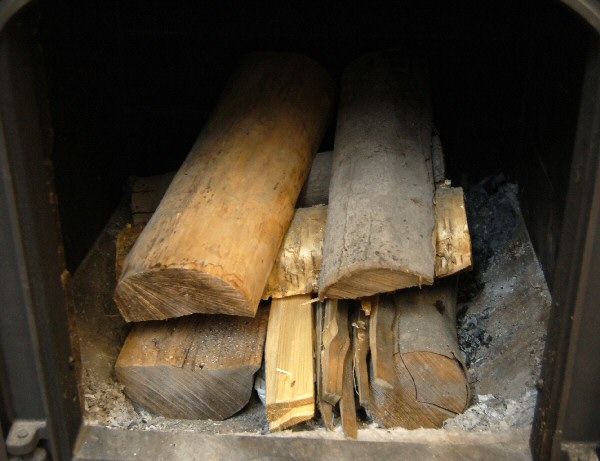
Fuel load stacked in firebox.
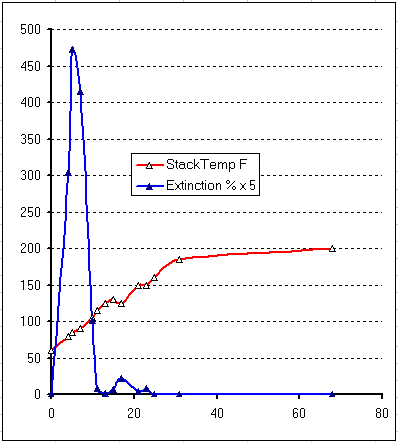
Graph of stack temperature and light extinction.
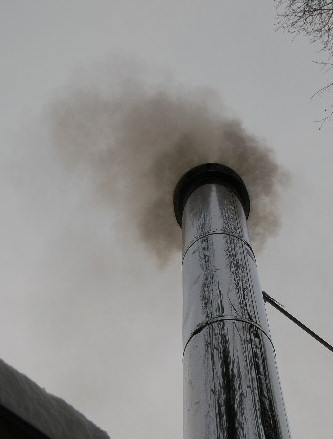
Photo taken at the opacity peak at 5 minutes.
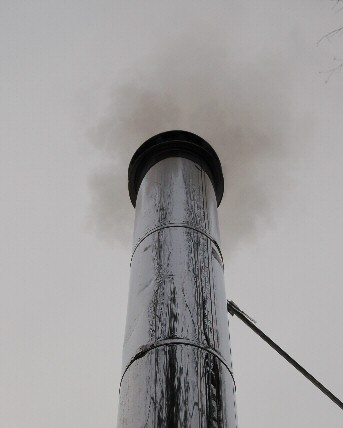
Photo taken 3 minutes later, when the opacity reading was near zero.
Stack temperature is low.
Steam can be seen condensing as it exits the chimney.
This has to be distinguished from smoke, and makes visual assessment
more complicated.
Comments:
The light extinction in the test section of flue seems
to be a
good predictor of visible smoke from the chimney.
Past particulate matter (PM-10) testing
experience at Lopez indicates
that visible smoke is a very good predictor of grams per kilogram
particulate emissions.
At this point, no calibration of the CdS sensor has been
done,
so the next step is to determine whether we are in the linear
range of the sensor's light response.
Further
Results :
February 6/06:
Paul Tiegs, principal at OMNI-Test, has
commented that opacity testing was tried in the 1980's with coventional
woodstoves, and did not find strong correlation with particulates.
Paul adds that EPA has a standard method, (U.S. EPA
Method 9), that requires readings to be made at various distances
downstream of the chimney exit, depending on the dissipation of
moisture particles. There is another test method that is in-stack, but
requires the gas stream to be higher than 350F or so, so that volatile
organics remain uncondensed.
In view of Paul's comments, we have done elementary
testing of the CdS sensor for linearity, but decided to concentrate
first on determining if this method as a whole is useful for the
particular case of masonry heaters.
Since we are measuring at the chimney entry, we do not
appear to be getting water condensation in the flue stream, but can't
be certain at this point. This requires some further investigation.
Since we are mainly investigating the cold start, it takes some time
before gas temperatures reach 350F.
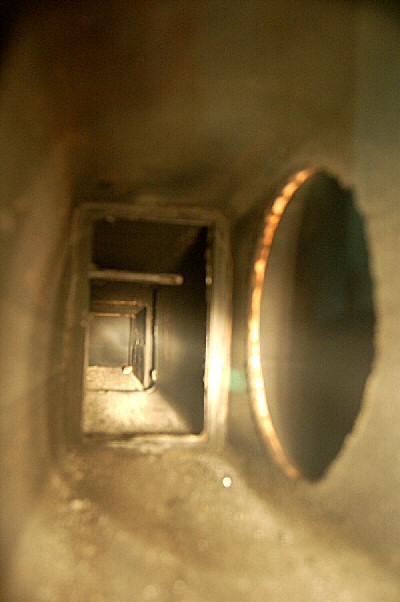
This is a view through the ceramic glass end cap on the
horizontal flue, illuminated by a flashlight beam, during combustion.
The far end (left side) downdraft channel is clearly
visible. Small particles of ash caught in the flashlight beam provide a
good visualization of the gas path and speed (not visible from the
photograph).
The thermocouple/draft probe is inserted through the
damper frame and visible.
February 8/06
We have conducted 2 more burns (G02 and G03). Both
times, there were some glitches with the CdS sensor setup, which should
be resolved for the next test.
You can view a 5 Mb animation of test G-03 here. It shows the startup
at 30 second intervals for the first 20 minutes, and 5 minute intervals
for another 40 minutes or so. Note: the flames
appear redder in the photos than they do to the eye. Fuel load was 62
lbs.
The Excel data for G03 (Feb 8) is posted: here
February 10/06
Here's a 4Mb animation of test G-04, with less air. Fuel
load was 55 lbs. All runs are with 8 pieces of fuel.
February 11/06
Here is an experimental
animation page of test G-05 and G-06, comparing the two burns.
February 12/06
An interesting test
February 13/06
An interesting test
to compare with February 12
|